Year-Round Climate Control: Monitoring Greenhouse Conditions in a Canadian Winter
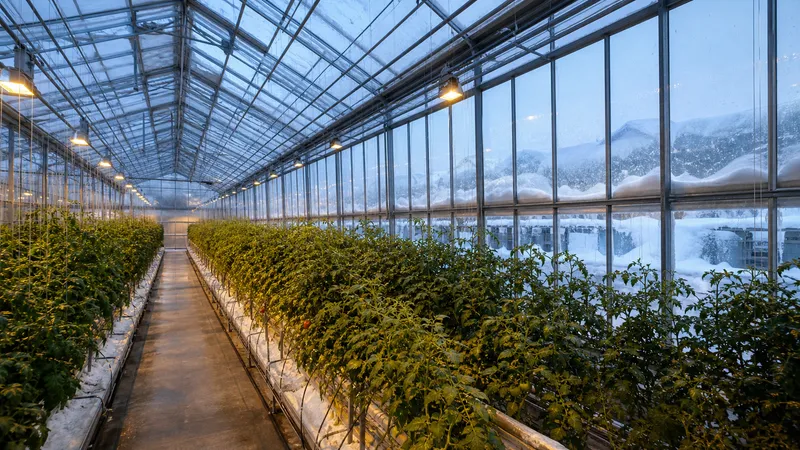
If you grow under glass or poly in Canada, winter is the season that decides whether your operation runs smoothly or absorbs an avoidable loss. The outside air can sit at minus 20 overnight and then climb above freezing under bright sun the next afternoon. Your structure has to manage that swing while keeping the canopy in a narrow range that the crop will actually tolerate.
This article is for greenhouse growers in the Leamington corridor, the BC Lower Mainland, Quebec, and anywhere else in Canada where winter production is a serious part of the business. It covers what makes winter climate control harder than other seasons, where primary control systems tend to fall short, and how independent environmental monitoring fills the gaps that lead to most overnight losses. If you are building out the broader growing-room strategy, pair it with CO2, humidity, and temperature monitoring and using sensor data to optimize growing conditions.
A modern climate computer is impressive equipment. It is also a single system, with a small number of sensors, running the same hardware that decides whether to open a vent or fire a boiler. When that system has a bad night, the crop pays for it.
What winter actually demands from a greenhouse
A greenhouse in January is doing several things at once. It is holding the canopy at a target temperature that may be 40 degrees Celsius warmer than the outside air. It is moving and exhausting moisture that builds up from transpiration and irrigation. It is dosing supplemental CO2 to keep photosynthesis productive during the short Canadian winter day. And on a sunny afternoon, it may need to vent aggressively to shed heat that would otherwise scorch the crop.
Each of those jobs depends on accurate readings and reliable actuators. Temperature sensors tell the controller when to call for heat. Humidity sensors trigger dehumidification cycles. CO2 sensors govern injection from a generator or liquid system. Vent position sensors confirm that the roof actually opened when the controller said so.
When any one of those signals drifts or fails, the controller keeps making decisions based on bad data. That is the part of winter operation that catches growers out.
Where standalone climate control systems fall short
Climate computers from manufacturers like Priva, Hoogendoorn, Argus, and Damatex are the backbone of commercial greenhouse operation. They are good at what they do. They also have structural limits that matter most in winter.
Single-point measurement. Most zones run on one or two aspirated sensor boxes. A 4,000 square metre bay is being managed off readings from a single spot in the canopy. Cold air falling from a leaky vent on the north wall does not register at the centre sensor until the damage is already underway.
Sensor drift. Temperature and humidity probes drift over time, particularly humidity sensors, which are sensitive to condensation, dust, and residue from pesticide or biocontrol applications. A probe that reads 3 percent low on humidity will keep the dehumidification system idle longer than it should, raising disease pressure without ever triggering an alarm.
The controller is the alarm. If your climate computer is the thing that detects problems and also the thing that has just frozen, lost power, or had a board fail, you have no independent witness. The same applies to network outages. If alerts only travel through the controller's internet connection, an ISP failure leaves you blind.
Limited coverage outside the zones. Heating loops, boiler rooms, pump rooms, and CO2 storage areas are rarely instrumented by the climate system. A boiler room that drops below freezing because the building heater failed can crack a pipe long before the canopy temperature gives anything away.
None of this is a criticism of the controller. It is a statement of what the controller was built to do and what falls outside its scope.
Common failure modes in a Canadian winter
The failures that ruin crops are usually mechanical, electrical, or both. They share a pattern: they happen at night or on weekends, they develop quickly once they start, and they often look like nothing on the controller's main screen until temperatures are already out of range.
Boiler failure overnight. A hydronic boiler that loses its flame on a minus 25 night can cool a glass house rapidly. As air temperature falls, relative humidity climbs toward 100 percent, and condensation begins to form on plants and structure once air or surfaces reach the dew point. By the time a controller's low-temperature alarm fires through whatever notification path is set up, the crop may already be in a stress event. Cold-tolerance varies by crop, cultivar, growth stage, and exposure duration, but warm-season fruiting crops like tomato, pepper, and cucumber generally show stress when canopy temperatures fall into the low teens or below for any sustained period.
Vent motor stuck open. Roof vent actuators are exposed equipment. A motor that fails in the open position, or a vent that ices up stuck partly open when it should be fully closed, pours cold air into the structure continuously. The controller calls for more heat to compensate. Gas bills climb, the crop is uneven, and unless someone walks the house in the cold, the mechanical failure is invisible.
Recirculation fan failure. Horizontal airflow fans keep canopy temperatures even and prevent cold pockets near the glass. When a fan motor burns out, the controller still reads the central sensor as on target. Plants near the failed fan sit in stratified cold air and pick up Botrytis or powdery mildew within days.
CO2 dosing errors. A CO2 generator that runs longer than intended, or a liquid CO2 control valve that sticks, can push concentrations to plant-stress or worker-safety levels. The opposite failure, an injection system that quietly stops dosing, gives up the photosynthesis gains that justified buying it in the first place. Crop response to elevated CO2 varies by species, cultivar, and light conditions, but sustained levels well above typical 800 to 1,200 ppm dosing targets can stress sensitive crops. On the worker-safety side, Ontario has historically referenced 5,000 ppm as an 8-hour exposure limit for workplace CO2; operators should verify current provincial occupational health and safety requirements for their jurisdiction.
Humidity creep. Winter humidity is harder to manage than summer humidity, because cold outside air carries little moisture and venting to dehumidify means dumping expensive heat. Controllers running tight energy budgets may let canopy humidity sit at high levels for hours. Disease pressure from Botrytis, downy mildew, and leaf mould rises with sustained high humidity, though the specific risk threshold depends on crop, cultivar, leaf wetness, and how long the conditions persist.
Power interruptions. Rural feeders go down. Generators do not always start. A short outage that interrupts the climate computer's sensor logging, or that leaves a controller stuck in an unexpected state when power returns, can leave you without a clear record of what happened during the gap.
What independent monitoring actually adds
The case for independent environmental monitoring is not that it replaces a climate computer. It is that it watches the same conditions with different hardware, on a different network path, with its own alerting. When something fails, you find out from the system that is not part of the failure.
Distributed sensors. Wireless temperature and humidity sensors placed every 15 to 25 metres through the canopy catch cold pockets, hot spots, and failed fans that a single aspirated box cannot see.
Boiler-room and equipment-room coverage. A sensor in the boiler room, the CO2 storage room, and any pump or fertigation room gives you early warning on building-systems failures that the climate computer does not monitor at all.
Independent communication path. A LoRaWAN gateway connected to a separate cellular link, or a sensor system that talks to a different ISP than the controller, keeps alerts flowing during network outages. For rural sites still comparing connectivity options, start with LoRaWAN vs WiFi for farm monitoring.
Continuous record. A monitoring platform that logs every reading every few minutes builds the post-event timeline that supports crop insurance discussions, helps diagnose what the controller did during a failure, and gives buyers documented evidence of your growing conditions.
Practical alert thresholds for winter
Thresholds should be set against your crop's tolerance, not the climate computer's setpoints. The point of a monitoring alert is to catch the deviation early, before the controller's own alarms fire and certainly before the crop is damaged.
Winter night setpoints vary by crop, cultivar, growth stage, and the grower's energy and pruning strategy. Common starting points used by Canadian growers include:
- Tomatoes roughly 17 to 19 degrees Celsius at night, often higher early in the day cycle, with strategy-dependent variation
- Cucumbers commonly 19 to 21 degrees at night
- Peppers in a similar range to tomatoes but with stronger sensitivity to growth stage
- Leafy greens and herbs highly variable, often cooler
Treat these as starting points to confirm against your seed supplier's guidance and your own production records, not fixed rules.
For most fruiting vegetable crops in a Canadian winter, useful starting points for alerts are:
Low temperature. Alert at roughly 2 degrees Celsius below your crop's night setpoint. This generally catches a boiler issue before canopy temperature reaches the cool side of your crop's target range.
High temperature. Alert at 3 to 4 degrees above day setpoint, which on a clear winter day usually indicates a vent that failed to open.
High humidity. Alert when relative humidity sits at sustained high levels for more than an hour. A common starting point is around 85 percent, but the right number depends on your crop, disease history, and leaf-wetness conditions.
Low humidity. Alert below 50 percent, which can indicate a vent stuck open or unusual heating behaviour.
CO2 levels. Set a crop-protection alert above your normal dosing target with margin, and a separate worker-safety alert tied to the current occupational exposure limit in your jurisdiction. Alert below 400 ppm during dosing hours to catch a stopped injection system.
Boiler-room temperature. Alert below 5 degrees Celsius to protect pipes and pumps from freezing if the building heater fails.
Adjust these to your crop, your structure, and what your team can realistically respond to overnight.
What to do next
If you are running a Canadian greenhouse through the winter and relying solely on your climate computer for alerts, the practical first steps are straightforward.
Walk every zone with a calibrated handheld and compare readings to your aspirated box. If the centre sensor is more than a degree off from the canopy average, you have already learned something useful. Check that your boiler-room and CO2-storage areas have any temperature monitoring at all. Confirm that your controller's alerts actually reach a phone outside business hours, and ask what happens to those alerts during a network outage.
From there, layering an independent monitoring system with distributed sensors and a separate alerting path is a practical way commercial Canadian growers reduce winter risk without replacing equipment that already works.
Storage Sentry is a wireless monitoring platform purpose-built for Canadian agricultural operations, helping greenhouse growers track temperature, humidity, and CO2 across every zone with independent alerting that runs outside the climate controller. Learn how Storage Sentry can help.
References
-
Ontario Ministry of Agriculture, Food and Rural Affairs. "Greenhouse Vegetable Production Recommendations (Publication 371)." omafra.gov.on.ca
-
Greenhouse Canada. "Managing humidity in winter greenhouse production." greenhousecanada.com
-
British Columbia Ministry of Agriculture and Food. "Greenhouse Vegetable Production Guide." gov.bc.ca
-
Ontario Ministry of Labour, Immigration, Training and Skills Development. "Occupational Exposure Limits (Regulation 833)." ontario.ca
-
Agriculture and Agri-Food Canada. "Crop Profile for Greenhouse Tomato in Canada." agriculture.canada.ca