What Happens When a Wash Line Pump Fails Mid-Shift
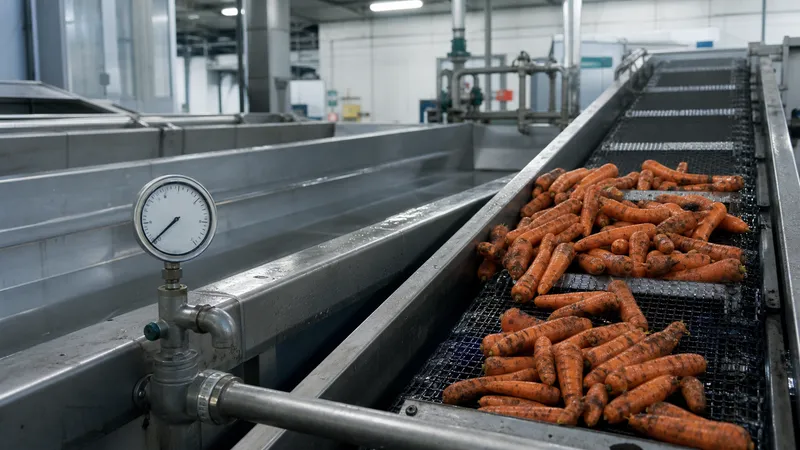
A wash line pump rarely fails dramatically. There is no bang, no warning light flashing in the operator's eye line, no obvious change in the noise of a packing house already running at 85 decibels. What usually happens is quieter: a pressure transducer that nobody is looking at starts trending downward, sanitizer concentration begins to slip, and product keeps moving down the belt because nothing has visibly changed. By the time someone realizes the wash is no longer doing its job, several hundred pounds of compromised product is already downstream.
This article is for produce washing and packing facility operators who want to understand what a mid-shift pump failure actually looks like as it unfolds, what the realistic recovery options are, and why catching the failure in the first few minutes rather than the first half hour changes the calculus completely. The companion piece on flow and pressure sensors covers the setup side; this one stays on the failure itself. For the room-level context around the same line, see packing facility monitoring.
Note: this is a practical overview, not legal or food safety engineering advice. Specific recovery decisions for your facility depend on your commodity, your equipment, and the corrective action procedures in your Preventive Control Plan.
The sequence of a mid-shift pump failure
Most pump failures during a shift fall into a predictable pattern. The exact timeline depends on the equipment and what failed, but the rough shape of the event tends to be similar.
Minute zero: the failure event. Something gives. A motor winding shorts, a coupling shears, a seal blows out and the pump loses prime, a bearing seizes, or a breaker trips on overload. In some cases the pump stops entirely. In others it keeps spinning but stops moving water because it has cavitated badly or lost its inlet. Either way, the water doing the work on your line is no longer arriving at the spray bars or recirculation loop at the intended rate.
Minute one to three: the line keeps running. Conveyor speed has not changed. The line tender is watching product, not gauges. The spray pattern looks roughly similar to a casual glance because the nozzles are still dribbling, just at a fraction of normal pressure. Sanitizer is being consumed by what is already in the wash tank, but no fresh dosed water is replacing it. Product is no longer getting the wash it was designed to get.
Minute three to ten: sanitizer drift begins. This is where the food safety risk starts to climb. If your line uses chlorinated wash water, free chlorine demand from product soil and organic load eats into available sanitizer quickly. Depending on how your system is plumbed (a single pump may handle circulation, dosing, and fresh water makeup, or those functions may be split across separate pumps), losing the affected pump can drop concentration below your operational threshold in well under ten minutes on a busy line. Pathogen cross-contamination risk rises with it. The product looks fine. The records would not look fine if anyone were looking at them.
Minute ten to twenty: somebody notices. The trigger is usually visual. A line tender sees a soggy patch on a belt that should be drying. A worker downstream notices product coming through dirtier than usual. A puddle shows up where it should not be. Or the supervisor walks past the pump skid and notices it has stopped.
Minute twenty onward: the response begins. The line gets stopped. The pump gets investigated. Somebody starts trying to figure out how much product has gone through under bad conditions, which is the question that determines how much the failure actually cost.
The bad-product window
The hard number behind a pump failure is how many pounds of product moved through the line while the wash was out of spec. A typical small to mid-sized produce wash line moves somewhere between 200 and 1,000 pounds of product per minute, depending on commodity and equipment.
A failure caught in five minutes, on a line moving 500 pounds per minute, puts roughly 2,500 pounds of product at issue. The same failure caught in thirty minutes puts 15,000 pounds at issue. On a high-throughput line, half an hour of unnoticed failure can compromise the entire morning's output.
The cost difference between those two scenarios is not just six times the product weight. It is the difference between a contained event you can manage with a hold and a reasonable rewash, and a major event that pulls in your QA lead, line workers redirected to sorting and disposal, and probably a phone call to a customer or two.
The recovery decision tree
Once the pump is stopped and the line is paused, the question is what to do with the product that went through during the bad-product window. There is no single right answer. The choice depends on the commodity, the severity of the deviation, what your PCP says, and what you can defensibly document.
Hold and rewash. For some commodities and some excursions, the most workable option is to hold the suspect product, restore the wash line to spec, and run the held product back through. This works best when the product is robust enough to survive a second pass, the sanitizer deviation was the main issue rather than physical soil load, and your PCP allows for rewashing as a corrective action. It is also the option that preserves the most value, since the product still ships.
Downgrade. When the product cannot defensibly go out as a Canada No. 1 grade but is not unsafe, downgrading to a lower grade or to a processing market may make sense. Buyers for processing typically pay less but accept product with cosmetic issues or higher tolerances. This option needs to align with your buyer agreements and your traceability records. It also requires honest assessment that the issue was quality rather than safety.
Discard. When the deviation is severe, when the commodity is high-risk (ready-to-eat leafy greens, for example), or when the records cannot support release of the product, discarding the affected lot is the conservative call. It is also the most expensive choice in the short term, which is part of why operators are tempted to look for reasons to release. Resist that temptation. A recall costs more than a discard, and a foodborne illness investigation costs more than a recall.
Investigate and document. Regardless of which disposition you choose, the event itself needs to be investigated and documented under your Preventive Control Plan. Your PCP records should be able to show the deviation, the affected product, the corrective action taken, the disposition of the product, and any preventive measures put in place to keep the failure from recurring. Inspectors care less about whether you had a failure, since failures happen, and more about whether you saw it, responded appropriately, and learned from it. That documentation should align with preventive control plan audit expectations.
Why early detection changes the math
A pump that fails at minute zero and is detected at minute three is a different event than one detected at minute twenty-five. The signals are usually there for the catching, but none of them helps if nobody is watching.
Continuous monitoring with sensible alerting flips the detection model. Instead of a person noticing wet product on a belt after the fact, a supervisor's phone buzzes within seconds of the failure. The pump may already be dead, but the line can be stopped before more than a handful of pounds of product passes through. The bad-product window shrinks from thousands of pounds to a few hundred or less.
This is not theoretical. The math is in the response time. Even a five-minute window still typically requires assessment, hold, disposition, and documentation depending on commodity and deviation severity, but the affected volume may be a single tote rather than pallets. A thirty-minute response window typically means pallet-scale product holds, harder downstream conversations, and a much bigger paper trail.
Practical next steps
If you have not thought through what a pump failure mid-shift would look like for your specific line, the first useful exercise is calculating your own bad-product window. Take your average throughput in pounds per minute and multiply it by your realistic detection time today. That number is your current exposure on every shift you run.
From there, the practical actions are reasonably narrow. Confirm that your pump has at least one continuous parameter being monitored (pressure, flow, motor current, or sanitizer concentration) and that the reading is visible to someone who can act on it. Confirm that your PCP has clear corrective action procedures for an out-of-spec wash event, so the recovery decision is not improvised under pressure. And confirm that the people running the line know what the alarm means and what to do in the first sixty seconds after it goes off.
Pump failures are not an avoidable category of risk on a wash line. The pumps work hard, they run wet, and they eventually wear out. What monitoring can reduce is the chance that the failure runs unnoticed for long enough to compromise pallets of product at the end of the belt.
Storage Sentry is a wireless monitoring platform purpose-built for Canadian agricultural operations. It connects sensors on your wash line, pump skid, and sanitizer system to real-time alerts, helping support faster response to equipment failures and cleaner records when something does go wrong. Learn how Storage Sentry can help.
References
-
Canadian Food Inspection Agency. "Guide for Preparing a Preventive Control Plan." inspection.canada.ca
-
Canadian Food Inspection Agency. "Preventive Control Plans: Record Keeping." inspection.canada.ca
-
Canadian Food Inspection Agency. "Safe Food for Canadians Regulations." inspection.canada.ca