Ventilation Failure in Livestock Barns: Reducing Risk Through Better Monitoring
Note: This is operational guidance, not legal, veterinary, or compliance advice. Welfare requirements vary by species, jurisdiction, and operation.
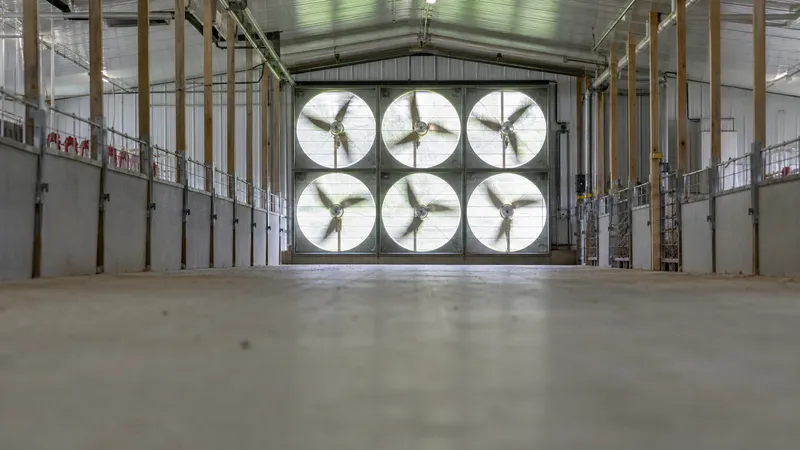
In a modern poultry, swine, or dairy barn, mechanical ventilation is not a comfort feature. It is life support for the animals inside. When the fans stop turning, the consequences can develop quickly, and under severe conditions a high-density barn can deteriorate within a very short response window.
This article is for livestock producers, barn managers, and farm staff who run climate-controlled barns and want to understand how ventilation systems fail, why the alarm panel mounted on the barn wall is not always enough, and what a layered monitoring setup looks like in practice. The focus is on Canadian conditions, where operators contend with everything from prairie summer heatwaves to deep cold snaps that freeze intake louvers shut. It pairs naturally with air quality monitoring for poultry and swine and the broader list of environmental factors agricultural facilities should monitor.
Why ventilation matters more than producers sometimes realize
A modern barn is a closed environment. The animals inside generate heat, moisture, carbon dioxide, and ammonia continuously. The ventilation system has three jobs running at the same time.
First, it dissipates body heat. A fully stocked broiler barn or finisher hog room produces a remarkable amount of metabolic heat, and on a warm day the temperature inside a barn with stopped fans can climb well past anything the animals can tolerate. Second, it removes moisture from respiration, manure, and drinking water spillage. Without airflow, humidity climbs quickly and bedding becomes wet, which compounds heat stress and creates conditions that favour disease. Third, it removes ammonia and carbon dioxide. Ammonia from urine and manure is irritating to the respiratory tract at low concentrations and harmful at higher ones. Carbon dioxide from respiration displaces oxygen.
In a sparsely stocked, naturally ventilated barn on a cool day, none of this is urgent. In a tightly stocked, mechanically ventilated barn on a warm or even moderate day, all of it is.
How quickly things go wrong depends on stocking density, animal size, outside temperature, and whether emergency curtain drops or sidewall openings are in place. Producers should not rely on rules of thumb pulled from another operation. The relevant question is how long the people responsible for any specific barn actually have between the moment the fans stop and the moment animals are in serious distress. In hot weather with a full barn of finishers or market-weight broilers, that window can be very short.
The most common ventilation failure modes
Mechanical ventilation systems are reliable when they are maintained, but they have a lot of moving parts and several single points of failure. The failure modes below come up regularly on Canadian operations.
Fan motor burnout. Exhaust fans run continuously through the warm months. Bearings wear, capacitors fail, and motors eventually burn out. A single failed fan in a bank of ten is not catastrophic, but a controller that does not recognize the failure, or a staged ventilation system that loses the wrong fan at the wrong moment, can leave a barn under-ventilated without any obvious warning.
Controller failure. The environmental controller is the brain of the system. When it freezes, reboots into the wrong program, loses calibration on its temperature probes, or simply fails outright, the rest of the system either does nothing or does the wrong thing. Controller failures are particularly dangerous because the fans may still be physically capable of running while the controller refuses to call for them.
Broken belts and seized pulleys. Belt-driven fans depend on a drive belt that wears, stretches, and occasionally snaps. A snapped belt means the fan blades stop while the motor keeps turning, which can fool a basic current-sensing alarm into thinking everything is fine.
Power outages. Rural power is not perfectly reliable, and a storm that takes out a line can leave a barn without ventilation at exactly the wrong moment. Generators help, but only if they start, only if they have fuel, and only if the transfer switch works. Each of those is its own failure point.
Frozen intake louvers in winter. This is a common cold-climate failure mode. Cold-weather minimum ventilation depends on a small amount of cold air entering through inlets while exhaust fans run. When inlets freeze shut after a damp cold snap, the fans run against a sealed barn, airflow falls, static pressure moves out of expected range, and ammonia and humidity climb. Animals suffer even though every fan is still turning normally.
Blocked or restricted inlets. Dust, cobwebs, insulation that has shifted, and inlets that have been propped at the wrong setting can all reduce incoming airflow. The fans keep running, the alarm panel sees nothing wrong, and air quality slowly deteriorates.
Curtain and emergency drop failures. Drop curtains and emergency sidewall openings are the last line of defence when the mechanical system fails. They depend on solenoids, fuses, latches, and sometimes thermal links that have to work correctly the first time. Operators occasionally discover after a hot afternoon that the drop curtain did not actually drop.
The common thread is that several of these failures can occur without a fan obviously stopping. The barn looks fine from the outside. The animals are not fine inside.
Why a barn-side alarm panel is not enough on its own
Almost every modern barn has an alarm panel of some kind connected to the environmental controller, often with a high-temperature horn or strobe and sometimes with an auto-dialer that phones a list of numbers. These systems are valuable, and a barn without one is exposed. But experienced producers have learned not to depend on the panel alone.
A few reasons stand out. The alarm often depends on the same controller that may have just failed, so a controller crash can take the alarm with it. The auto-dialer depends on a working phone line or cell signal, neither of which is guaranteed on a rural property during the kind of storm most likely to cause an outage. Someone has to be close enough to hear the horn or pick up the phone, which often is not the case at night or on a weekend. Phone trees fail when staff change shifts, change numbers, or simply do not answer. And a temperature sensor mounted in the wrong spot, or one that has drifted out of calibration, will not raise an alarm at all even when the air at animal level is outside acceptable welfare limits and can cause severe distress or death depending on duration.
The barn alarm should be one layer of several, not the only layer.
What independent monitoring adds
A well-designed monitoring layer sits beside the barn controller, not inside it, and reports independently to the cloud. The point is to have an independent verification layer that does not depend on the same hardware that just failed.
A reasonable setup includes independent temperature and humidity sensors at animal level in each zone, power-loss sensors on the main panel and downstream of the generator transfer switch, and static pressure sensors that confirm the barn is actually pulling air across the inlets. Ammonia and carbon dioxide sensors add value in tightly stocked rooms where air quality can degrade without temperature changing much. For the financial case behind adding that layer, see crop-loss prevention monitoring ROI.
Alerts should reach more than one person by SMS and email, with an escalation path if the first contact does not acknowledge within a defined window. A phone-accessible dashboard lets an operator verify the situation before driving back at two in the morning. Historical data supports troubleshooting and provides documentation if an animal care or insurance question comes up.
What monitoring cannot prevent
No monitoring layer prevents every bad outcome. It will not stop a fire, a structural collapse, or a total power loss in a scenario where backup power and communications also fail. It depends on working sensors, charged batteries, and reachable cellular or network coverage. Sensor failure, dead batteries, a cellular outage, or an event that progresses faster than the response time of the people on call will still cause harm. The point of monitoring is to widen the window for response, not to guarantee one.
What the Codes of Practice expect
The National Farm Animal Care Council publishes species-specific Codes of Practice, including separate Codes for chickens raised for meat, pullets and layers, pigs, and dairy cattle. The Codes expect producers to maintain appropriate ventilation oversight and respond to failures, but they do not prescribe specific monitoring technology. The intent is that producers have practices in place to increase the chance of early detection and a faster response when ventilation goes wrong.
A practical setup for most operators
For most small to mid-sized barns, the starting point is one temperature and humidity sensor per ventilation zone, mounted at animal level away from direct fan airflow and heaters, plus a power-loss sensor on the main panel and a second downstream of the transfer switch if there is a generator. Set high-temperature, low-temperature, and high-humidity thresholds that reflect the tolerances of the animals at their current age and weight, and revisit those thresholds when stocking changes. Test the full alert chain quarterly by triggering a real alarm and confirming everyone received it.
For larger or tightly stocked operations, or tunnel ventilation in summer heat, add static pressure monitoring and consider ammonia and carbon dioxide sensors. None of this replaces the barn controller and its built-in alarms. It runs alongside them.
Ventilation failures are not common, but they are not rare either, and the cost of one bad event in a full barn makes a second monitoring layer easy to justify.
Storage Sentry is a wireless monitoring platform purpose-built for Canadian agricultural operations, helping support livestock producers with independent temperature, humidity, and power monitoring that runs alongside existing barn controllers and sends redundant alerts when something goes wrong. Learn how Storage Sentry can help.
References
- National Farm Animal Care Council. "Codes of Practice for the Care and Handling of Farm Animals" (species-specific Codes for chickens for meat, pullets and layers, pigs, and dairy cattle). nfacc.ca
- Ontario Ministry of Agriculture, Food and Agribusiness. Agriculture and agribusiness guidance. ontario.ca
- Canadian Food Inspection Agency. Animal welfare overview. inspection.canada.ca