Using Sensor Data to Optimize Growing Conditions Without Guesswork
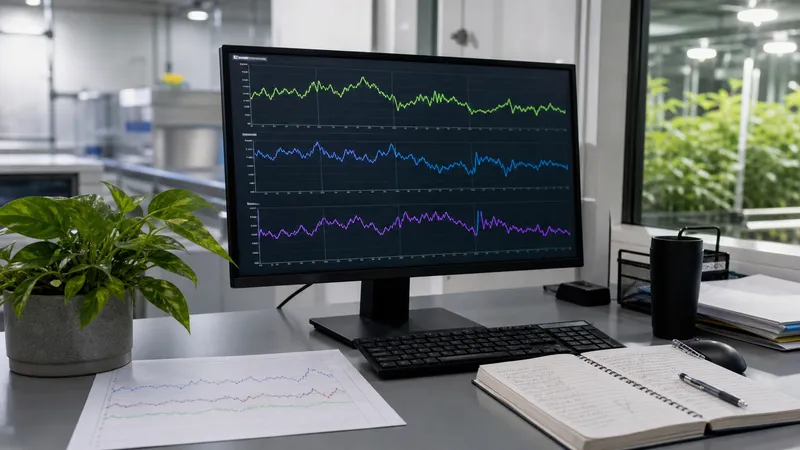
If you already run environmental sensors in your growing operation, you have probably noticed that most of the time the data just sits there. The dashboard runs in the background. Alerts fire when something crosses a threshold. The rest of the readings, the millions of points that describe a normal day, never really get looked at.
This article is for indoor and greenhouse growers in Canada who already have basic monitoring in place and want to start using their data more strategically. It is about the shift from monitoring-as-alarm to monitoring-as-feedback, and the practical habits that turn a season of readings into better decisions next season. For the alarm-first foundation, see year-round greenhouse climate control; for the physiology behind the readings, see how CO2, humidity, and temperature work together. There is no magic feature here. Optimization, when it is honest, is gradual data-informed iteration. The growers who do it well are the ones who built a routine around looking.
A quick note on what this article is not. It is not a recipe. Targets and setpoints depend on your crop, your cultivar, your structure, and your light environment. What follows is a way of thinking about the data you already collect, with examples grounded in the science most commercial growers will recognize.
Monitoring as feedback, not just alarm
Alarm-style monitoring asks one question: is anything wrong right now. That question is necessary, and a good monitoring system should answer it well. But it is also a low ceiling. You can run a perfectly alert-free week and still have left meaningful yield, quality, or energy savings on the table.
Feedback-style monitoring asks a different question: what does this room actually do, and how does what it does relate to what the crop actually produced. The answer lives in the long tail of normal readings, the ones that never tripped an alert.
This shift matters because the relationships between climate and crop performance rarely show up in a single reading. They show up in patterns over hours, days, and weeks. A canopy temperature that runs 1.5 degrees higher on average through the second half of the day cycle. A morning vapour pressure deficit that collapses for an hour before the lights come up. A CO2 dosing window that ends 45 minutes earlier than you thought because the vents open sooner on cloudy days. None of those are alarm conditions. All of them shape the crop, which is the same mindset behind moving from reactive to proactive farm management.
The growing science worth knowing
You do not need to be a plant physiologist to use feedback monitoring well, but a few concepts make the data far more readable.
Daily light integral. DLI is the total amount of photosynthetically active light a crop receives over 24 hours, measured in moles per square metre per day. It matters because most crops have a productive DLI range, and giving them more or less than that range either wastes electricity on supplemental lighting or leaves yield behind. If your monitoring includes a PAR or quantum sensor, accumulated DLI per day is one of the most useful numbers you can track over a growing cycle.
Vapour pressure deficit. VPD is the difference between how much moisture the air is holding and how much it could hold at that temperature. It governs transpiration, nutrient uptake, and to a large degree disease pressure. Two rooms at the same relative humidity can be in very different VPD conditions if their temperatures differ. Tracking VPD instead of, or alongside, raw humidity is a small change that pays off quickly.
Heat-degree-day accumulation. Many crops respond to accumulated warmth above a base temperature rather than to any single day's high. Tracking how much heat your crop has actually accumulated over a cycle can explain why one batch finished early and another lagged, even when the daily averages looked similar.
You do not need to optimize against all of these at once. Start with the one most relevant to the problem you most want to solve.
A weekly review habit
The single highest-leverage change most growers can make is scheduling 30 to 45 minutes a week to look at the previous seven days of data deliberately. Not glancing at it. Looking at it.
A practical weekly review looks like this. Pull up your environmental charts for the week, side by side across all zones. Note any day where the crop did something interesting, faster growth, slower growth, a flush, a quality issue, an unexpected disease finding. Then look at what the environment was doing on that day and the two or three days leading up to it. Patterns rarely jump out from a single review. They emerge over a month of reviews, when you start to see the same conditions associated with the same outcomes.
Write things down. A short note in a logbook or a shared document, with the date and what you observed, builds an institutional memory that no dashboard can replace. Six months later, when you are trying to remember whether the strong harvest in week 14 lined up with the cooler nights or the higher CO2 mornings, the notes will tell you and the data will confirm.
Tactics for using the data well
These are the practices that separate growers who get better every year from growers who run the same recipe forever.
Compare crop performance to environmental data, not just yield to yield. When a batch overperforms or underperforms, do not just compare yield numbers across cycles. Pull the environmental charts for both cycles and look for what was different. Higher DLI on average. Tighter VPD at night. Less time outside the productive temperature range. The differences are often visible if you look.
A/B test one variable at a time. If you want to know whether a 1 degree warmer night setpoint actually improves your crop, change only that variable and run it for a meaningful period, ideally across two zones with otherwise identical conditions. Changing three things at once and then attributing the result to one of them is how growers convince themselves of things that are not true. Sensor data is what makes a clean A/B test possible, because you can confirm afterwards that the only variable that actually moved was the one you intended to.
Look at zone-to-zone differences as information. Most multi-zone facilities have one zone that quietly outperforms or underperforms the others. The instinct is to treat this as the structure being uneven and move on. The better instinct is to ask what the data shows about that zone, then decide whether to bring the others closer to it or to fix what is making it different.
Track time-in-range, not just averages. A daily average can hide a lot. A zone that averages 22 degrees with a 4 degree swing is a very different environment from one that averages 22 degrees with a 1 degree swing. Calculating what percentage of the day each zone spent in your target temperature, humidity, or VPD range gives you a more honest measure of climate stability than averages do.
Watch the morning and evening transitions. The two windows where most environmental problems hide are the hour around lights-on or sunrise and the hour around lights-off or sunset. Big changes happen quickly, control systems are working hard, and the crop is responding to a shifting environment. A surprising amount of disease pressure and stress originates in those windows. They are also the windows most underexamined in a typical weekly review.
Use heat-degree-day or DLI accumulation to explain crop timing. When a batch finishes early or late, do not just shrug at it. Pull the accumulated DLI or heat-degree-days for that cycle and compare to a typical cycle. Often the explanation is sitting in the data.
Where this approach has limits
Sensor-data-driven optimization has real limits and it is worth being clear about them.
Your data is only as good as your sensor placement and calibration. A drifted humidity probe or a sensor sitting in direct sun will tell you confident stories about a room you do not actually have. Walk your sensors with a calibrated handheld at least seasonally.
Correlation is not causation. The week your tomatoes hit a quality issue may have lined up with a humidity excursion, or it may have lined up with three other things you did not measure. Treat patterns as hypotheses to test, not conclusions to act on.
Some of the highest-value variables for crop performance, root zone EC and pH, irrigation timing, pruning strategy, biocontrol programs, are not in your environmental sensor data at all. Climate optimization works best when it sits inside a wider production review.
What to do next
If you have monitoring in place but are mainly using it for alerts, pick one habit from this article and try it for a month. The weekly review is the most universally useful starting point. Block the time on your calendar, pull up the previous seven days, and write down what you see. After four weeks you will have a real picture of how your climate behaves and where the easy wins likely are.
From there, the next step is usually adding one or two readings you do not currently capture. A PAR sensor for accumulated DLI, a CO2 sensor at canopy level if you only measure return air, or VPD calculated alongside humidity. Each one opens up a question you could not answer before.
Optimization is not a feature you turn on. It is a habit you build, supported by data you already collect. The growers who do it well are not the ones with the most sensors. They are the ones who actually look.
Storage Sentry is a wireless monitoring platform purpose-built for Canadian agricultural operations, helping growers track temperature, humidity, CO2, and light across every zone and turn a season of readings into decisions worth acting on. Learn how Storage Sentry can help.
References
-
Ontario Ministry of Agriculture, Food and Rural Affairs. "Greenhouse Vegetable Production Recommendations (Publication 371)." omafra.gov.on.ca
-
Agriculture and Agri-Food Canada. "Crop Profiles." agriculture.canada.ca
-
British Columbia Ministry of Agriculture and Food. "Greenhouse Vegetable Production Guide." gov.bc.ca