Packing Facility Monitoring: Temperature, Humidity, and Food Safety
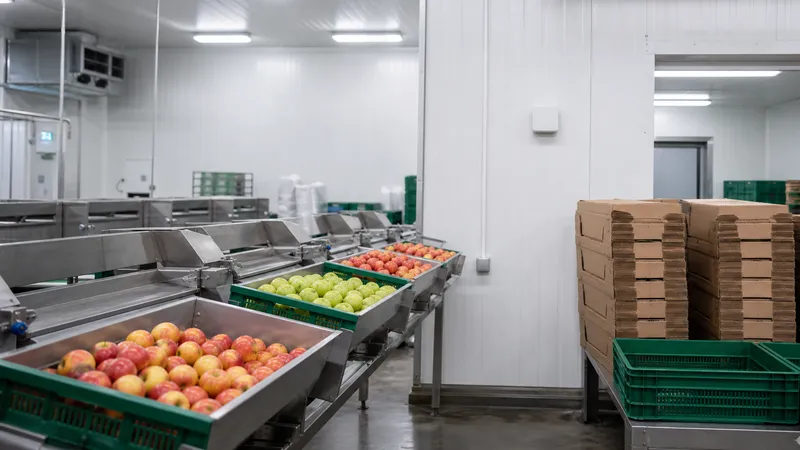
A packing room sits in an awkward spot in the food system. It is not a cooler, so it does not get the dedicated refrigeration attention a cold room does. It is not a warehouse, because the product moving through it is perishable and often unpackaged. It is the room where temperature and humidity have to be controlled well enough to protect quality and safety, but where doors are constantly opening, workers are constantly moving, and conditions change every time a new pallet arrives.
This article is for operators of Canadian packing facilities: apple and pear packers, vegetable packers, meat processors, and producers of ready-to-eat foods like sandwiches, salads, and prepared trays. It walks through why the packing environment matters, how packing rooms lose temperature and humidity control, what SFCR-style record expectations look like, and what a practical monitoring setup looks like. For equipment-side risks in the same facility, see wash line flow and pressure monitoring and mid-shift pump failure response.
Note: This is a practical overview, not legal or food safety advice. Specific requirements vary by commodity, regulated activity, and your facility's Preventive Control Plan. Consult the CFIA or a qualified food safety professional for guidance specific to your operation.
Why the packing room environment matters
Most operators understand why a cooler needs to stay cold. The packing room gets less attention because product is supposedly only in it briefly. In practice, "briefly" can mean two or three hours per pallet on a busy day, and the cumulative time the day's pack spends in the packing environment often exceeds the time any one item spends in the cooler.
When packing room temperature drifts upward, respiration accelerates. Fresh produce continues to respire after harvest, and that respiration roughly doubles for every 10°C increase. A packing room sitting at 15°C is using up shelf life roughly twice as fast as one at 5°C. For ready-to-eat foods, meat products, and cut produce, the warmer concern is pathogen growth in the temperature danger zone above 4°C.
Condensation is the third issue. Bring a pallet from a 1°C cooler into a 20°C packing room with high humidity and the surfaces of the boxes, the product, and the packaging materials sweat. That moisture is a vehicle for cross-contamination, a substrate for mould on cardboard, and a reason for retail rejection on packaged loads.
Humidity has its own list of problems. Too low and unpackaged produce loses weight, leafy greens wilt, and root vegetables shrivel on the line. Too high and packaging absorbs moisture, labels lift, cardboard softens, and mould finds a foothold on anything porous. The right band depends on what is being packed, but for most fresh produce operations it sits somewhere between 60 and 85 percent.
Common failure modes in packing environments
Packing rooms tend to fail in predictable ways. The patterns are different from cold storage because the room is open, busy, and shared.
Doors propped open at receiving. The single most common loss of control. A forklift driver props the receiving door open while pallets come off a trailer, and over twenty minutes warm outside air mixes with the conditioned packing room air. In summer this can push room temperature up several degrees and humidity by 20 percent or more. The HVAC eventually catches up, but the product on the line went through warmer, wetter air the entire time.
HVAC zoning that does not match the work. A packing facility often started as a single room and grew into several. The HVAC was sized for the original layout. After a few expansions, one zone is over-conditioned while another sits warm and stagnant. The reading near the thermostat looks fine; the reading over the line, twenty metres away, tells a different story.
Iced evaporator coils. When evaporator coils ice over, airflow drops and the room stops cooling effectively. Coils ice for several reasons: a stuck defrost cycle, a dirty coil that runs colder than designed, doors letting in humid air that freezes on the fins, or a refrigerant issue. The symptom is a slow upward drift in room temperature that the system cannot reverse.
Gradual climb during a pack run. A common pattern on a busy day: the room starts at setpoint, then climbs half a degree per hour as warm pallets arrive, workers generate body heat, and the HVAC cannot quite keep up. By mid-afternoon the room sits two or three degrees above where it should be. Nobody has done anything wrong, but the room has quietly slid out of spec for hours.
Shared air with the wash room. Where packing and wash rooms share air, either through an open doorway or a common HVAC return, humidity from the wash side bleeds into the packing side. Packing room humidity can climb into condensation territory without anyone making a single change in the packing room itself.
Cleaning cycles that change everything. Wet sanitation at end of shift drops temperature, raises humidity, and resets the room for the next day. If the next shift starts before the room recovers, the first hour of pack happens in conditions that look nothing like the rest of the run.
Sensor placement that hides the problem. A single sensor mounted on a wall near the office door reads wall temperature, not product zone temperature. The room sensor reports compliance with the setpoint while the actual product sits twenty metres away in a different microclimate. The records look clean, but they were measuring the wrong place.
What CFIA and SFCR expectations look like
Under the Safe Food for Canadians Regulations, most regulated food businesses are required to have preventive controls, and many need a written Preventive Control Plan identifying hazards and the controls used to manage them. For packing operations, environmental control is generally part of that plan, even when it is not called out as a specific critical control point.
What inspectors typically expect depends on the operation, but a few themes are consistent. Records should show that conditions stayed within the limits the operator has set, should be complete, dated, and retrievable for the retention period the plan specifies, and if a deviation occurred there should be a corrective action recorded against it.
A pack run with no environmental record is a hole in the file, and it is the kind of hole an inspector will ask about. Continuous logging makes the record automatic and makes it possible to show conditions for the entire shift, not a handful of spot checks taken when somebody remembered. That same records problem is explored in automated compliance reporting and SFCR record retention.
What a practical monitoring setup looks like
You do not need to instrument every square metre of the facility to gain real coverage. A reasonable setup has a few characteristics.
Treat the facility as zones, not as one room. A typical packing line has at least three meaningful zones: receiving, the active pack line, and any holding or staging area for finished product. Each is a different microclimate. Each needs its own sensor.
Use more than one sensor per zone for anything that matters. A single sensor can fail or drift, and a single sensor in a busy room will always have a placement debate. Two or three sensors per significant zone cost very little more and reveal microclimates that a single sensor cannot.
Place sensors in the product zone, not near doors or thermostats. A sensor near a doorway tells you what the doorway is doing. A sensor at packing line height, away from supply registers and return grilles, tells you what the product is actually experiencing.
Set alerts that match the pack run, not the empty room. A 6°C alert that triggers correctly at 3 AM with an empty room may scream all afternoon during a normal busy run. Thresholds need to reflect what conditions are achievable while the room is in active use, with separate expectations for between shifts. Otherwise the alerts get muted and the system stops doing its job.
Capture humidity alongside temperature. A combined temperature and humidity sensor costs roughly the same as a temperature-only sensor and adds half the information you actually need. Humidity excursions tend to precede condensation, mould complaints, and packaging issues, so seeing humidity creep is worth as much as seeing temperature creep.
Log continuously and retain. Whatever your retention requirement is, a system that logs every few minutes to a platform you can pull reports from is materially easier to defend at audit than a paper logbook with gaps. Continuous data also makes trend reviews possible, which is how you catch a slowly icing coil or a drifting setpoint before either turns into a real problem.
Practical next steps
If you operate a packing room and want to tighten environmental control, a few starting points cover most of the risk.
Walk your line during a pack run with a handheld meter. Compare readings at the pack line to readings near the thermostat. If they disagree by more than a degree or two, the wall sensor is not telling you what you think it is.
Identify the door that is propped open the most. Strip curtains, an air curtain, or a simple door alarm pays for itself the first hot afternoon it prevents.
Decide what conditions you actually need. Write down the temperature and humidity band that protects your product and your records. Without a target, monitoring data is just data.
Add continuous logging if you do not already have it. Even a starter setup with two or three sensors in the zones that matter will catch most of the failure modes above and create the record your auditor expects.
The packing room is one of the easiest places in a food facility to under-monitor and one of the most expensive places to discover a problem after the fact. Most of what goes wrong is gradual, recoverable, and visible if anyone is looking. Continuous monitoring is how you make sure someone is.
Storage Sentry is a wireless monitoring platform purpose-built for Canadian agricultural operations. It places temperature and humidity sensors across your packing facility, from receiving to the pack line to finished goods, and turns the readings into alerts and time-stamped records, helping support food safety and consistent product quality. Learn how Storage Sentry can help.
References
-
Canadian Food Inspection Agency. "Guide for Preparing a Preventive Control Plan." inspection.canada.ca
-
Canadian Food Inspection Agency. "Preventive Control Plans: Record Keeping." inspection.canada.ca
-
Canadian Food Inspection Agency. "Safe Food for Canadians Regulations." inspection.canada.ca
-
Ontario Ministry of Agriculture, Food and Agribusiness. "Postharvest Handling of Horticultural Crops." omafra.gov.on.ca