Manual Temperature Logs vs. Automated Monitoring: Risk, Cost, and Compliance Compared
If you run a food business in Canada that handles anything temperature-sensitive, somebody on your team is writing temperatures down on a clipboard or punching them into a spreadsheet right now. That has been the default for decades, and for good reason. A thermometer and a log sheet are cheap, familiar, and they have kept Canadian food safe for a long time.
But automated wireless sensors have become significantly less expensive over the last few years, and a lot of operators are reasonably asking whether the old way is still the right way. This article compares both approaches: the real labour cost of manual logs, the risk profile each carries, what the regulations actually require, total cost over a year, and what the audit experience looks like. For the larger business case, see farm monitoring ROI scenarios and insurance documentation expectations.
The honest answer is that it depends, and there are scenarios where manual logs are genuinely fine.
Note: This article is a practical overview, not legal advice. Specific compliance obligations under the Safe Food for Canadians Regulations vary by food type, business activity, and trade model. Consult the CFIA or a qualified food safety professional for guidance on your operation.
What we mean by each approach
Before getting into the comparison, it helps to be precise about what is actually being compared.
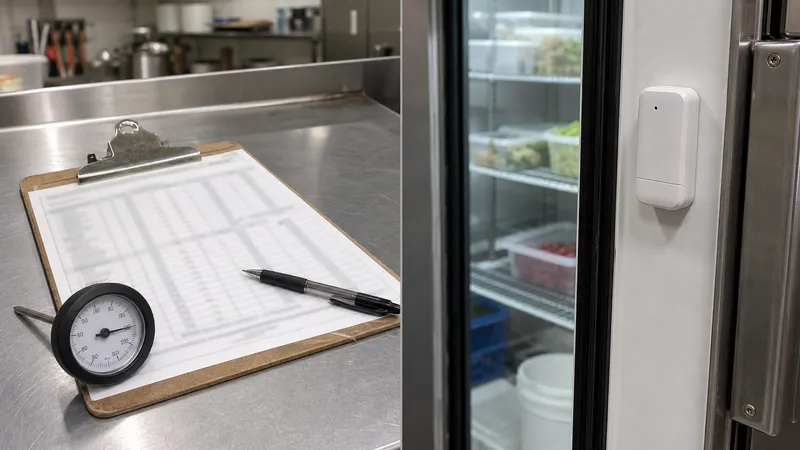
A manual temperature log is what most people picture: a person physically reads a thermometer (analog or digital), writes the value, the date, the time, and their initials on a paper sheet or types it into a spreadsheet. This typically happens at set intervals, often twice or three times a day for a walk-in cooler or freezer.
Automated monitoring uses a wireless sensor placed inside the storage space. The sensor takes a reading every few minutes and transmits it over LoRaWAN, WiFi, or cellular to a cloud platform. The platform stores the readings, generates alerts when values cross a threshold, and produces records you can export when needed.
Both approaches can satisfy regulatory record-keeping in principle. They differ enormously in the work they require and the gaps they leave behind.
The four dimensions that matter
Labour cost over a year. A manual check sounds quick, but the round trip of stopping work, reading the thermometer, writing the value, and getting back to whatever you were doing is rarely under three to five minutes. Three checks a day across three coolers at four minutes each works out to about 219 hours a year. At an illustrative loaded labour rate of $25 an hour (actual loaded rates vary by province, role, overtime, benefits, and whether the owner-operator is doing the check), that is roughly $5,475 spent on temperature logging alone, and most operators do not have this number on a line item anywhere.
Risk profile. Manual logs have characteristic failure modes that automated systems do not share. The most obvious is the gap, when the person responsible is sick, off shift, or simply forgot. Less obvious is the missed event between checks: a cooler that fails at 7 PM Friday and is not checked again until Monday morning has 60 hours to spoil inventory before anyone knows. Add transcription errors, fading legibility on sheets stored in cold or damp spaces, and the issue inspectors quietly call pencil-whipping, where readings get filled in after the fact. Automated systems are not magical, sensors fail and connections drop, but those failures are different and generally visible in the data.
Compliance posture. The SFCR does not mandate automated monitoring. It is outcome-based: per CFIA guidance, records should be legible, permanent, accurate, dated, signed by the responsible person, made at the time of the event, include units of measure, and reflect what actually happened. A diligently kept paper log meets that standard. So does a properly configured automated system. Where the two diverge is in defensibility. A paper log with neat handwriting can still raise questions if an inspector notices that all 14 weekend overnight checks were written in the same pen at the same slant, or if there are no records covering the three days the regular operator was off sick. An automated system produces timestamped readings at consistent intervals that are difficult to fabricate after the fact. Both can comply. Automated systems are typically easier to defend during a detailed review, especially when paired with SFCR record retention planning.
Capital cost vs ongoing cost. Manual logging has essentially no equipment cost beyond a thermometer and a binder, but it has a recurring labour cost every single year that operations rarely measure. Automated monitoring has an upfront sensor and gateway cost, plus a monthly subscription, and the labour involved drops to occasional verification rather than continuous logging. Over three to five years, the cost lines often cross. For a single small cooler, manual is cheaper. For multiple storage points or a larger operation, automated typically comes out ahead even before you factor in spoilage events avoided.
What the audit experience actually looks like
The comparison gets concrete during a CFIA inspection or an insurance claim.
With manual logs, the inspector asks for your records. You pull binders off a shelf or open a spreadsheet folder, and the inspector flips through looking for completeness, legibility, and corrective actions when readings were out of range. Any gap becomes a question you need to answer, and a request for trend data means somebody has to compile it.
With automated monitoring, you generate a date-range export that shows every reading from every sensor over the requested period. Out-of-range events are flagged with the alert that was triggered and, if the system is configured and used properly, the corrective action logged alongside. The conversation tends to be shorter.
Neither outcome is automatically better. A spotless paper log presented confidently can be entirely sufficient. The difference shows up when records have gaps, which many manual-logging operations face at some point. Operations that integrate checks into a fixed routine, such as a cooler check tied to opening or closing, can mitigate this risk considerably.
Where manual logs genuinely make sense
A single fridge or freezer in an attended workplace, where someone is on site every day and inventory value is modest, is the clearest case. Adding sensors and a subscription for one cooler that already gets checked anyway is overhead that does not pay for itself. A very small farm operation with one cold storage space and a diligent owner-operator on site at predictable times is similar: the labour cost is absorbed into the existing routine.
Operators with a strong preference for paper, low comfort with software, and a track record of diligent record-keeping are also a reasonable fit. The best monitoring system is the one that actually gets used.
Where automated wins
The economics tip toward automation as you scale and as the consequences of a missed event grow.
Multiple storage locations multiply manual labour linearly: each new cooler is more time per day, more sheets to file, more places gaps can form. Automation costs grow more slowly because the infrastructure is shared across sensors.
Higher-value inventory raises the cost of any single failure. A walk-in holding $20,000 of finished product makes a missed weekend failure a major loss event. The cost of a sensor that would have caught it is rounding error against that risk.
Unattended hours are the strongest case. Overnight, weekend, and holiday coverage with manual logging means either paying someone to come in or accepting a gap. Automated monitoring covers those hours by design.
Compliance scrutiny that goes beyond the basics also pushes toward automation. Operations that export, ship to large retail buyers with their own audit requirements, or have had a prior incident generally find digital records worth the cost.
A simple decision framework
If you are weighing the two for your operation, four questions will get you most of the way there.
- How many storage points need monitoring? One is borderline. Three or more often justifies automation on labour alone, though heavily routine-integrated operations with strong record habits can stay manual longer.
- What is the typical value of inventory at risk per storage point (an individual cooler, freezer, or holding room)? As a rough decision heuristic rather than a hard rule: below a few thousand dollars per storage point, manual is defensible. Above that, the cost of one prevented spoilage event covers years of monitoring.
- Is the facility attended every day, including weekends and holidays? If not, manual logging will have gaps that automation does not.
- Do your customers, insurer, or regulator expect digital records? Some retail buyers and an increasing number of commercial insurers, particularly for higher-value inventory, treat continuous monitoring as a baseline expectation, though this varies heavily by insurer, coverage tier, and sector.
If your answers point toward one storage point, modest inventory, full attendance, and no external pressure for digital records, manual logging is genuinely fine. If two or more answers point the other direction, the math often favours automation.
A practical takeaway
The clipboard is not broken. It is just expensive in ways most operators have never added up, and it carries risks that only show up when something has already gone wrong. Automated monitoring is not magic either. It costs money, it requires that you set it up correctly, and it produces no value if nobody acts on the alerts.
The right question is which approach fits your operation given the number of storage points, the value of what is inside them, the hours those spaces are unattended, and what your customers and regulator expect. For many Canadian food businesses, that calculation has shifted in recent years as sensors and connectivity have gotten cheaper while the cost of a missed event has not.
If you have been logging temperatures on paper for years and it has worked, that is real evidence. If your binders have the occasional gap, that is also real evidence. Look at the actual records honestly, and decide from there.
Storage Sentry is a wireless monitoring platform purpose-built for Canadian agricultural operations. We provide continuous temperature and humidity sensors with automatic alerts and audit-ready record exports, helping support compliance with SFCR record-keeping requirements. Learn how Storage Sentry can help.
References
-
Canadian Food Inspection Agency. "Preventive control plan for food businesses: Record keeping." inspection.canada.ca
-
Canadian Food Inspection Agency. "Understanding the Safe Food for Canadians Regulations: A handbook for food businesses." inspection.canada.ca
-
Canadian Food Inspection Agency. "Fact sheet: Outcome-based regulations under the Safe Food for Canadians Regulations." inspection.canada.ca
-
Canadian Food Inspection Agency. "Regulatory requirements: Preventive controls for food businesses." inspection.canada.ca
-
Health Canada. "Food Safety and You." canada.ca