LoRaWAN vs WiFi for Farm Monitoring: What Actually Works in Rural Conditions
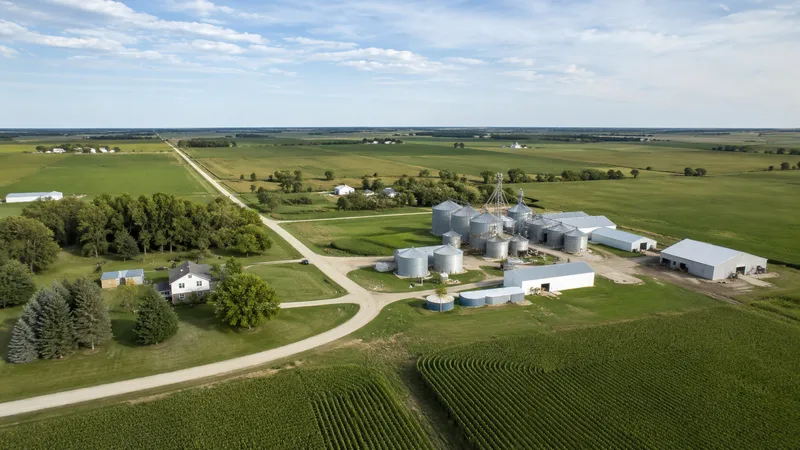
If you have ever tried to put a WiFi-connected sensor in a grain bin, a back barn, or a walk-in cooler, you have probably already learned the lesson the hard way. WiFi works beautifully in the house and in the office. It struggles, sometimes badly, the moment you ask it to cover a working farm.
This article is for anyone who runs a rural agricultural operation and is trying to decide how to monitor temperature, humidity, water, or equipment across more than one building. It compares WiFi and LoRaWAN side by side, explains where each one actually works, and gives you a simple way to figure out which one fits your property.
For background on LoRaWAN itself, see A Beginner's Guide to LoRaWAN Sensors for Facility Monitoring. This article focuses on the comparison. Once you are past the protocol choice, the next questions are real-world LoRaWAN range and sensor battery life.
Why WiFi struggles on a farm
WiFi was designed to cover a house, an apartment, or an office floor. It was not designed to cover a yard with three outbuildings, a grain leg, and a packing shed. Three things tend to go wrong when operators try to push WiFi past its intended environment.
Range. Even strong outdoor WiFi loses useful throughput well before it loses signal entirely. A high-quality access point might still show a connection at 300 feet, but the actual data rate at that distance is often too low and too unstable for reliable sensor reporting. Inside a building with normal construction, the working range drops to something closer to 50 to 100 feet from the access point.
Obstacles. WiFi runs on 2.4 GHz and 5 GHz, both of which are absorbed or reflected by the materials common in agricultural buildings. Metal siding, insulated panels, concrete walls, stored grain, and the stainless steel walls of a walk-in cooler all attenuate the signal severely. A cold room is essentially a Faraday cage. Wet conditions inside a greenhouse or a barn make things worse.
Power. WiFi radios are power-hungry compared to low-power wireless protocols. A WiFi sensor either needs to be plugged in or it needs batteries that get changed every few weeks. If you have thirty sensors spread across the property, swapping batteries becomes a recurring job nobody wants to do.
None of this is WiFi's fault. It is a perfectly good technology for what it was built to do. The problem is that monitoring a working farm is not what it was built to do.
What LoRaWAN does differently
LoRaWAN is a long-range, low-power wireless protocol built specifically for the kind of work WiFi is bad at: small amounts of data, sent infrequently, across long distances, on battery power.
A LoRaWAN sensor takes a reading every few minutes, broadcasts a short message, and goes back to sleep. A gateway, typically a single device mounted somewhere central on your property, picks up those messages and forwards them to a cloud platform. From there, the data flows to your dashboard, your alerts, and your records.
A few characteristics matter for rural use:
- Sub-GHz radio frequency, which penetrates walls, metal, and structures far better than the bands WiFi uses
- Practical outdoor range of several kilometres in line-of-sight rural conditions, and useful indoor range across multiple buildings
- Battery life measured in years, not weeks, because the radio is off most of the time
- One gateway typically covers an entire farm operation, where the same area would require many WiFi access points
The tradeoff is bandwidth. LoRaWAN is not designed to stream video or transfer large files. For environmental monitoring, where each reading is a few bytes of data, that limit does not matter.
Side by side
| WiFi | LoRaWAN | |
|---|---|---|
| Typical outdoor range | ~50 to 150 ft of useful signal | 2 to 15 km, line of sight |
| Through walls and metal | Poor past one or two walls | Penetrates multiple walls and metal-clad structures |
| Battery life | Weeks to months | 3 to 10 years |
| Cost per sensor | Often higher | Generally lower |
| Infrastructure | Multiple access points to cover a property | Typically one gateway |
| Best fit | Single building with existing network | Multi-building, outdoor, rural sites |
When WiFi is still the right call
Not every monitoring problem needs LoRaWAN. WiFi remains the better choice in some situations, and pretending otherwise would be dishonest.
If your monitoring is confined to a single building with strong existing WiFi coverage, and the sensors you need already include WiFi radios that work in that environment, there is no reason to add new infrastructure. WiFi is also the right choice if you need to move a lot of data, such as cameras, image-based plant analysis, or anything that streams video. LoRaWAN cannot do that. Use the right tool for the job.
The trouble is that most rural agricultural operations do not fit this description. They have multiple buildings, outdoor sensors, sensors behind metal walls, and sensors in places nobody wants to run electricity to.
Where LoRaWAN clearly wins
These situations come up regularly on Canadian farms, and they are the cases where LoRaWAN is not just better, but is often the only option that works reliably.
Grain bins across a yard. WiFi will not consistently reach the bins at the far end of the yard. One LoRaWAN gateway mounted on the shop covers all of them, and the temperature and moisture sensors run for years on a battery.
Walk-in coolers and freezers. The insulated metal walls that keep cold in also keep WiFi out. A sensor placed inside the cooler often cannot find an access point even when the access point is in the next room. Sub-GHz LoRaWAN passes through.
Outbuildings 100 metres or more from the house. This is the most common scenario. The farmhouse has good WiFi. The barn, 200 metres down the lane, does not. Stringing access points to cover the distance is expensive and finicky. A single LoRaWAN gateway handles the whole property.
Greenhouses with metal frames and high humidity. WiFi handles wet conditions poorly. LoRaWAN does not notice them.
Pump houses, wellheads, and remote tanks. No power, no problem. A battery-powered LoRaWAN sensor can sit on a wellhead for half a decade and report water levels without anyone touching it.
A simple way to decide
If you are weighing the two for a specific operation, walk the property with a notebook and answer four questions.
- How far is the furthest sensor from your nearest network access point? If it is more than about 100 feet or has walls in the way, WiFi will probably not be reliable.
- How many buildings or structures are involved? More than one usually pushes you toward LoRaWAN.
- How often do you need a reading? Environmental monitoring almost always works fine with a reading every few minutes, which is well within LoRaWAN's capabilities.
- How tolerant are you of changing batteries? Trips out to the back of the property to swap batteries on a WiFi sensor get old quickly.
If most of your sensors are in one building near a good access point, WiFi is fine. If your monitoring spans multiple buildings, outdoor locations, or anywhere without convenient power, LoRaWAN is almost certainly the better answer.
A note on cellular
Cellular monitoring is a third option worth mentioning briefly. Each sensor has its own SIM and reports directly to the cloud over LTE or LTE-M. This works well for a single remote location that is genuinely isolated. It tends to be more expensive per sensor, both in hardware and in monthly data fees, and it relies on having usable cellular coverage at the sensor location. For a farm with many sensors spread across a property, LoRaWAN is usually cheaper and more reliable.
The practical takeaway
For most rural Canadian agricultural operations, the choice comes down to this: WiFi covers the office and the house, and LoRaWAN covers the actual working areas of the farm. They are complementary, not competing. The mistake is assuming that the WiFi that works fine in the kitchen will somehow also work in the back barn. It will not, and discovering that after you have already bought sensors is an expensive way to learn the lesson.
If you are planning a monitoring setup, start with the question of where you actually need readings. Then pick the technology that gets you there reliably, on a battery, without rewiring half the property.