How Spoilage Spreads in Stored Grain (And How to Stop It)
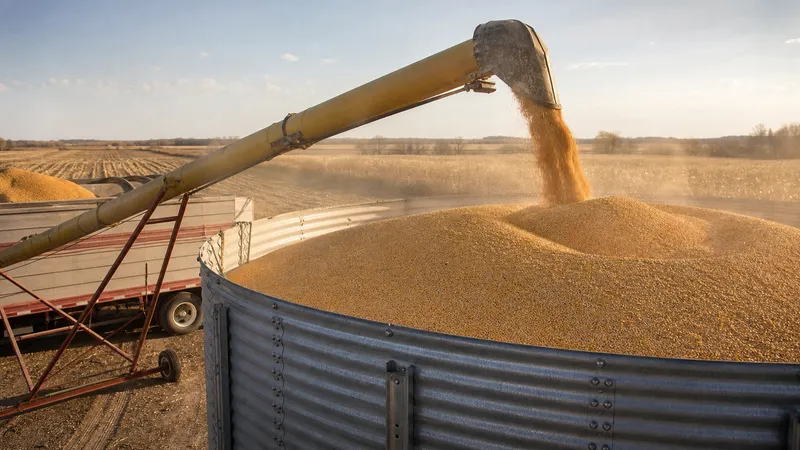
Grain spoilage is not really a storage problem. It is a biology problem that happens to take place inside a bin. The kernels in storage are alive, the moulds and bacteria living on them are alive, and so are the insects that turn up after harvest. Everything in the mass is respiring, and aerobic respiration produces heat, water, and carbon dioxide. When the conditions tip in their favour, the organisms produce enough heat and water to feed their own growth, and a localized problem turns into a bin problem.
This article is for prairie and Ontario grain farmers who want to understand the actual mechanism behind stored grain spoilage. Not the cues to watch for or the thresholds to set, but what is happening biologically when a bin starts to go and why it moves so quickly. Companion pieces cover hot spot detection, the moisture and temperature pairing, and post-harvest grain storage best practices.
The reason early intervention matters so much is that stored grain spoilage is a self-reinforcing biological process. Caught at the start, it is reversible with aeration or turning. Caught later, the damage is done and the question becomes how much of the bin you save.
What is actually living in your grain
A clean-looking bin of dry wheat or canola is not sterile. Field fungi like Alternaria and Fusarium arrive on the kernels at harvest. Storage fungi, mainly Aspergillus and Penicillium species, grow inside the bin once moisture allows. Yeasts, bacteria, and the grain itself respire at low rates throughout storage. This is the baseline state of stored grain.
What changes is the rate. Microbial activity is governed by water availability, expressed for stored grain as equilibrium relative humidity in the inter-kernel air. Most storage moulds need an equilibrium relative humidity above roughly 65 to 70 percent to grow, which corresponds to different moisture contents depending on the crop. Wheat reaches that range around 14.5 percent moisture. Canola, with its high oil content, hits it closer to 8 percent. Below those thresholds, the bin is biologically quiet. Above them, the clock starts.
Temperature multiplies whatever moisture allows. Microbial activity roughly doubles for every 10°C rise within the range that matters for storage. Cold grain at marginal moisture can hold for months; the same grain at 20°C can deteriorate in weeks. The two variables compound, which is why neither tells the whole story alone.
The feedback loop that makes spoilage spread
Here is the part that surprises operators new to grain storage. Spoilage does not just continue at a constant rate once it starts. It accelerates, because the by-products of microbial respiration are themselves heat and water vapour. Heat raises the metabolic rate of organisms already present, and water vapour raises the local water activity (or equilibrium relative humidity) around the affected pocket, allowing more organisms to become active.
Picture a small pocket of grain at 14 percent moisture and 10°C, just above the safe threshold. Moulds begin to respire, raising the local temperature by a couple of degrees and adding water vapour to the inter-kernel air. The warmer, moister microclimate lets neighbouring kernels support more mould growth than they did an hour ago. Those kernels respire more actively, contributing more heat and water. The pocket expands.
This is the positive feedback loop at the centre of nearly every bin failure. Once established, it does not slow down on its own. It only stops when something external removes the heat and moisture faster than the organisms can produce them, which usually means cold dry aeration air moving through the affected zone.
The phases of progression
Stored grain spoilage moves through reasonably distinct stages. Knowing where a bin sits on this progression is the difference between a manageable problem and a writeoff.
Latency. Grain is at or near a marginal moisture and temperature combination, but no measurable activity is underway yet. This phase can last weeks or months and gives no obvious external signal. Trend data showing creeping temperatures or rising humidity at one sensor is the only early indicator.
Initiation. A localized pocket begins active microbial respiration. Local temperature climbs slowly, often half a degree to a degree per week at first. Moisture in the inter-kernel air rises in the affected zone. The grain still looks and smells fine to a person standing on the manhole. A continuous sensor in the right place can already see a divergence.
Acceleration. The feedback loop is established and the affected zone expands measurably day to day. Temperature rise speeds up, often climbing several degrees a week. A faint musty or sour smell may appear. Caking begins as fungal hyphae bind kernels together. This is the last phase where aeration alone can usually stabilize the bin.
Caking and heating. Core temperature pushes through 25 to 30°C. Mesophilic moulds give way to thermophilic species. The grain forms a solid mat, airflow collapses, and aeration can no longer reach the active grain. Mycotoxin production becomes a real risk. The bin generally needs to be turned or transferred, not just aerated.
Critical heating. Core temperatures above 40 to 50°C indicate runaway thermophilic activity. The grain in the affected zone is unsalvageable, and surrounding grain is at risk from heat and moisture migrating out of the pocket. Bin fires, while uncommon, originate in this phase.
The transition from initiation to acceleration is where most of the practical opportunity sits. Catching a bin at initiation gives you days of cushion. Catching it at acceleration gives you hours.
Insects add their own heat
Stored grain insects are part of the same energy budget. They split into primary pests, which can attack sound undamaged kernels (granary weevil, lesser grain borer, rusty grain beetle), and secondary pests, which need broken grain, dust, or already damaged material to feed (red flour beetle and similar). All of them respire as they feed and reproduce, and a sufficient population in a localized zone can raise temperatures enough to seed a hot spot independently of mould activity. Red flour beetles in particular cannot feed on undamaged dry seed below roughly 12 percent moisture, so finding them usually points to fines and broken kernels in the bin. The rusty grain beetle is well documented at generating measurable temperature rises in prairie wheat, barley, rye, triticale, oats, milled products, and heated flax.
Insects also do something moulds do not. They move, spreading laterally to find the warmer pockets where reproduction is fastest. The combination of insect heat and mould respiration is more dangerous than either alone, because insects can shift moulds into more favourable conditions just by warming new zones. Cold grain below roughly 15°C dramatically slows insect reproduction, which is why winter cooling is so effective at protecting a bin.
Mycotoxins outlast the spoilage
Even after the spoiled grain is removed, the chemical legacy can remain. Storage moulds in the Aspergillus and Penicillium genera can produce mycotoxins, including ochratoxin A, under the warm humid conditions of an active spoilage pocket. In Canadian stored grain, ochratoxin A is most often associated with Penicillium verrucosum growing on damp grain. Fusarium species, more often a field problem, produce deoxynivalenol and other mycotoxins that may already be present in affected lots from field infection.
Mycotoxins are the quiet half of the cost. Grain might be visually salvageable after cleaning, but contamination above buyer thresholds can downgrade or reject a load. The Canadian Grain Commission and end users test for these compounds at multiple points in the supply chain, and rejection thresholds are low. A single mismanaged bin can contaminate downstream blends if it gets past the operator, which is one of the strongest practical reasons to catch spoilage in the initiation phase.
Where the reversibility line sits
Grain spoilage is reversible while it is still mainly a temperature and moisture problem, and irreversible once it becomes a structural and chemical one. Below roughly 25°C with no caking, cool dry aeration can break the feedback loop and return the grain to a stable state. Above roughly 30 to 35°C with caking present, the affected grain has lost commercial value and needs to be physically removed by turning or transferring the bin. Aeration will cool the surrounding grain but cannot rehabilitate a caked zone.
Reading the data biologically
Monitoring cues map onto specific points in the feedback loop. Interpreting them that way, rather than as isolated alarm thresholds, is what makes early intervention possible.
A single sensor diverging upward while its neighbours stay flat usually means microbial respiration has started in a localized pocket and the heat is accumulating faster than conduction can carry it away. The biology is in the initiation phase. Inter-kernel humidity climbing in the same zone, without a matching change outside the bin, is the water-vapour half of the same process. When temperature and humidity rise together at one sensor, the feedback loop is established and worth acting on within hours.
A faint musty or sour odour at the manhole means volatile metabolites have accumulated to detectable levels, which only happens after the loop has been running for a while. Visible caking, surface crust, or mould means fungal hyphae have bound kernels together and aeration can no longer reach the active grain.
The biology of stored grain spoilage will not change. What does change is how quickly you find out it has started. Continuous monitoring, in the end, is just a way of compressing the time between when the feedback loop begins and when somebody knows about it. The shorter that gap, the smaller the problem stays.
Storage Sentry is a wireless monitoring platform purpose-built for Canadian agricultural operations. We help grain farmers catch the early temperature and humidity drift that signals microbial activity, before a small spoilage pocket grows into a bin-level problem. Learn how Storage Sentry can help.
References
-
Canadian Grain Commission. "Monitor Stored Grain." grainscanada.gc.ca
-
Canadian Grain Commission. "Protect Stored Grain from Insects." grainscanada.gc.ca
-
Canadian Grain Commission. "Storing Grain on the Farm." grainscanada.gc.ca
-
Canola Council of Canada. "Storage." canolacouncil.org
-
Government of Saskatchewan. "Grain Storage Management." saskatchewan.ca