How Much Crop Loss Can You Prevent With a $99/Month Monitoring System?
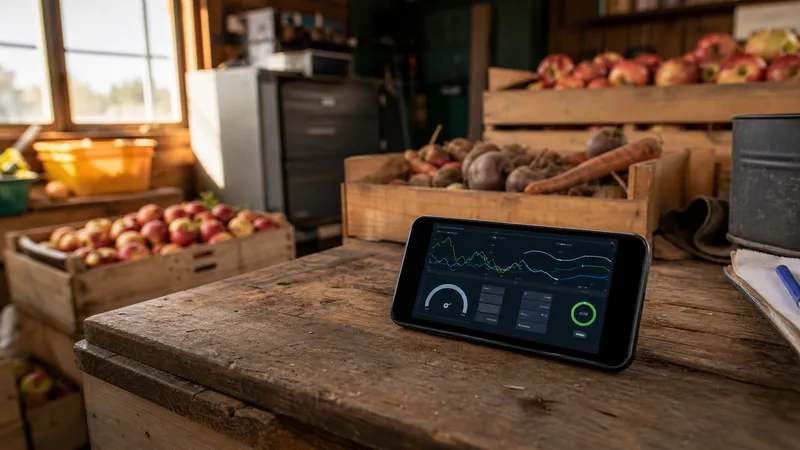
If you run a small or mid-size farm in Canada, you have probably been pitched some version of a wireless monitoring system at some point. The pitch tends to be the same: put sensors in your buildings, get alerts on your phone, save your crop. The numbers tend to be vague.
This article is for operators trying to figure out whether a system in the rough range of $99 a month is actually worth the spend. Not in marketing terms, in farm terms. We will walk through three realistic Canadian scenarios where monitoring pays for itself many times over, then look at the cases where it would not have helped. The goal is to give you enough information to make the call honestly. If you need a broader scale comparison, read the real ROI of farm monitoring alongside how automated alerts save money.
Note: The numbers in this article are illustrative. Actual losses depend on your inventory levels, market prices, herd size, insurance coverage, and how fast you can respond when an alert comes in. Use these as scale, not as projections.
The basic math
At roughly $99 per month, monitoring costs about $1,188 per year. With installation and sensors, a typical small-farm deployment lands somewhere between $1,500 and $2,500 in year one, and closer to the base subscription after that. Your actual year-one cost will depend on how many sensors you need, your connectivity model (cellular, LoRaWAN, Wi-Fi), whether you self-install or hire it out, and add-ons that fall outside a basic package, such as grain-bin temperature cables.
The question is not whether that is cheap in absolute terms. It is what monitoring has to prevent in order to be worth the spend. For most Canadian farms, one avoided incident over several years pays back the whole investment, and most operations are exposed to more than one kind of risk.
Scenario one: a heat spike in a small produce farm cooler
You run a small market-garden operation in southern Ontario. Your walk-in cooler holds the week's pick on a Saturday afternoon: flats of strawberries and raspberries headed to the farmers' market on Sunday, plus salad greens and some early field tomatoes. At peak weekend, you have around $4,000 of product in the cooler.
The failure. Compressor trips out on a Saturday at 7 PM. Nobody is in the cooler again until 6 AM Sunday. Internal temperature climbs from 4°C to 18°C over the night. Berries collapse fast, mould blooms within hours, and what was market-grade Saturday is compost Sunday. Salad greens wilt. Tomatoes bruise under the warmer flats.
The cost. Around $4,000 in product, plus a Sunday calling regular customers to apologise, plus the emergency call to the refrigeration tech. Call it $5,000 to $6,000 all in.
What monitoring changes. A temperature sensor inside the cooler sees the rise within 15 to 30 minutes of the compressor trip. You get a text, drive over, and reset the breaker. Worst case, you ice the product down and move what you can to a neighbour's cooler. The loss is a few flats, not the whole weekend. The same event is covered in more detail in walk-in cooler failure prevention.
Against $1,188 a year, a single prevented event of this scale pays back monitoring for four to five years.
Scenario two: a hot spot in a 5,000 bushel canola bin
You farm a few quarters in central Saskatchewan and store canola through the fall to catch better prices. One bin holds about 5,000 bushels, tough but not bone-dry. At around 14 CAD per bushel at typical recent prices, that bin is worth roughly $70,000, though cash bids vary by region and season. A grade downgrade for heated grain can knock $2 to $4 a bushel off the price. A bin fire is a different disaster entirely.
The failure. A pocket of higher-moisture seed in the centre of the bin begins to respire. Temperature in that pocket climbs from 15°C to 35°C over a couple of weeks, then accelerates. By the time you climb the bin for a routine check, you are dealing with heated grain, possible mould, and a problem that could spread. In a worse case, sustained heating in oilseeds can lead to a bin fire.
The cost. A modest downgrade on a 5,000 bushel canola bin is roughly $10,000 to $20,000. A serious heating event that requires turning, drying, or partial discounting runs higher. A bin fire can mean total loss of the grain plus damage to the bin, which is six figures before cleanup and lost storage capacity.
What monitoring changes. Bin cables or wireless probes report grain temperature at multiple depths every few hours. A 5°C rise above neighbouring sensors over a few days is a clear signal to turn the bin or run aeration. You catch the heating before it becomes a grading problem, let alone a fire. The cost of acting early is some fan hours and half a day of moving grain.
This is where the payback can be strongest. One prevented downgrade event covers ten years of subscription.
Scenario three: ventilation fan failure in a livestock barn
You run a finishing barn for hogs in southwestern Manitoba. The barn is mechanically ventilated, and in summer it depends entirely on those fans to keep temperatures and air quality survivable for the animals inside.
The failure. A summer thunderstorm knocks out power around noon. The generator should kick in, but the transfer switch has a fault nobody knew about, and it does not. The controller is dead, so its built-in alarm cannot dial out. Inside the barn, temperatures climb fast in the still air. Animals begin to suffer heat stress within hours, and depending on barn type, herd size, and weather, mortality can begin not long after.
The cost. Hog mortality in a single ventilation failure can range from a handful of animals to nearly the entire group, depending on barn size and how long the failure lasts. Even a partial loss on a barn of 1,000 finishers is six figures, and the welfare implications go beyond money.
What monitoring changes. A temperature sensor inside the barn, on its own battery-backed wireless network, sees the rise regardless of whether the main controller is alive. It sends alerts to your phone, your hired hand, and a backup contact. If someone can get there in time, the response might be opening doors, running portable fans, or calling for help. The earlier the warning, the better the chance of limiting losses, but the outcome still depends on response time and who is available to act.
For livestock operations, this scenario alone is generally enough to justify monitoring, provided you have a written response plan and backup contacts who can act on alerts when you cannot. The annualised cost is a rounding error against the value of a single barn of livestock.
Where monitoring would not have saved you
It would be dishonest to pretend monitoring is a universal answer. There are real cases where the system is not going to help, and you should know what they look like.
Catastrophic, instantaneous events. A tornado that takes the roof off a bin, a barn fire that starts in the electrical panel and spreads in minutes, a flood that arrives faster than anyone can respond. Monitoring tells you what is happening, but it does not change the outcome.
Slow market or biological losses outside the monitored environment. A crop disease that develops in the field, a price collapse, a buyer that walks away from a contract. None of that is what sensors are for.
Failures where you cannot respond in time anyway. If you are eight hours away on vacation with no one to send to the farm, an alert at 2 AM does not save you. Monitoring works as part of a response plan, not in place of one.
Sensor or network failures. Like any system, monitoring can have its own outages. Battery dies, gateway goes offline, alert does not get through. Quality systems are reliable, but no monitoring system is going to be right 100% of the time.
Honest assessment: monitoring covers a wide band of slow-developing or detection-window failures, which is most of what actually goes wrong on a farm. It does not cover the dramatic, low-probability events that most insurance policies are built for, though the records can still matter for insurance and liability conversations.
A simple way to decide
If you are weighing whether the spend makes sense, ask three questions:
What is the largest single loss you are exposed to? If you have a building or a bin or a herd that represents more than $10,000 in potential loss from a detectable failure, monitoring pays back fast. The bigger that number, the more obvious the math.
How long would it take you to notice a problem otherwise? If the answer is hours or days, monitoring closes that gap to minutes. If the answer is "we are in the building every hour," the value is smaller.
Can you actually respond when you get an alert? Monitoring is a force multiplier, not a substitute. If you live an hour from the farm and have nobody on site, an alert at 3 AM only helps if you have a plan for what to do with it.
For most small to mid-size Canadian farm operations, the answer to question one alone may be enough to tip the math. Cold storage, grain storage, and livestock are all in the category where one prevented incident covers years of subscription. For operations without any of those exposures, the spend is a closer call.
Monitoring is not magic. It is a relatively cheap insurance policy against the kinds of failures that actually happen on a working farm. Whether it is worth it for your operation depends on what you have to lose and how fast you would otherwise find out.
Storage Sentry is a wireless monitoring platform purpose-built for Canadian agricultural operations. It tracks temperature, humidity, and other environmental conditions across coolers, grain bins, barns, and outbuildings, and sends alerts when something goes wrong. Learn how Storage Sentry can help.
References
-
Canadian Grain Commission. "Storing Grain on the Farm." grainscanada.gc.ca
-
Canola Council of Canada. "Storage." canolacouncil.org
-
Government of Manitoba. "Mortality Risk in Hot Weather: Ventilation in Hog Barns." gov.mb.ca
-
Second Harvest & Value Chain Management International. "The Avoidable Crisis of Food Waste." secondharvest.ca