How Far Can a LoRaWAN Signal Really Travel? Real-World Range on Canadian Farms
If you have been looking at LoRaWAN sensors for your farm, you have probably seen range claims that sound almost too good. Ten kilometres. Fifteen kilometres. Forty kilometres in one famous test from a hot air balloon. Those numbers are real, but they are also misleading if you are trying to plan a monitoring setup for an actual working farm with bins, barns, trees, and metal everywhere.
This article is for any Canadian operator who is sizing up LoRaWAN and wants a clear answer to the question that actually matters: what range can I expect on my property, with my buildings, in my conditions? It walks through the physics in plain language, then through three realistic farm layouts so you can see how the numbers play out.
If you are still deciding whether LoRaWAN is the right protocol for your operation, start with LoRaWAN vs WiFi for Farm Monitoring. This piece assumes you have made that call and now want to know where to put the gateway. For the maintenance side of the same planning work, review sensor battery life and the basics of LoRaWAN sensors.
The headline numbers, and what they actually mean
LoRaWAN's published range figures generally come from one of two scenarios. The first is true line-of-sight outdoors with no obstacles between sensor and gateway, often with both mounted high. In that case, distances of 10 to 15 kilometres are achievable in rural conditions and have been demonstrated many times. The second is dense urban deployment, where one to three kilometres is more typical because of buildings and reflective surfaces.
A working farm is neither of those. It is mostly rural and quiet on the radio spectrum, which helps. But it is also full of objects that absorb or reflect radio waves: metal-clad bins, insulated cooler panels, full grain, tree windbreaks, wet ground, equipment, and the rolling terrain most farms sit on. Each of those quietly steals some range.
A useful starting point for planning: depending on building construction, antenna height, and site conditions, indoor-to-gateway range often lands somewhere between 500 metres and 2 kilometres, with outdoor-to-gateway range typically in the 2 to 5 kilometre window when the gateway is mounted high and reasonably placed. Treat those as planning brackets, not promises. The only way to know what your specific site supports is to test a sensor at the furthest planned location before committing to permanent mounts. You can do better with a good antenna and a tall mount. You can do far worse if the gateway sits on a desk in the basement of the farmhouse.
What actually steals range
LoRaWAN uses sub-GHz frequencies (915 MHz in Canada), which penetrate walls and structures much better than the 2.4 GHz band WiFi uses. That advantage is real, but it is not unlimited. Five factors do most of the work in shortening range from the theoretical maximum.
Terrain. LoRaWAN is a radio protocol, not magic. A hill, a rise, or even a substantial dip in the land between sensor and gateway will block signal. The Canadian Prairies are friendlier to LoRaWAN than the Niagara Escarpment or the Annapolis Valley for this reason.
Foliage and trees. Wet leaves are surprisingly effective at absorbing sub-GHz radio. A shelterbelt of mature spruce or poplar between a remote sensor and the gateway can knock down range by half or more, especially in summer when the canopy is full.
Building materials. Wood and concrete attenuate signal modestly. Metal siding, steel roofing, and insulated metal panels attenuate it significantly. A walk-in cooler or freezer is the worst case, since it is essentially a sealed metal box. Signal still gets out, but at reduced range. As a rough example, a cold room of typical construction might only push usable signal 100 to 300 metres beyond its walls, though the actual figure varies widely depending on panel thickness, door seals, and what is stored inside.
Stored product. A full grain bin attenuates signal noticeably more than an empty one. Sensors mounted inside or on top of full bins lose some of their range budget before the signal even reaches the bin wall.
Gateway height. This is the single biggest variable you control. A gateway mounted at three metres performs dramatically worse than the same gateway mounted at ten metres. Height clears local obstacles and improves the line-of-sight geometry to distant sensors. If you take one thing from this article, it is that gateway height matters more than gateway brand.
Three real-world farm layouts
Here is how the numbers tend to shake out across the layouts we see most often on Canadian operations.
Small mixed farm: house, barn, two grain bins on two hectares. This is the easiest case. A single gateway mounted on the peak of the house roof or on a short mast above it will typically cover the entire yard with strong signal to spare. Distances are short, usually under 200 metres between gateway and the furthest sensor, and even with metal-clad bins and a barn in the way, signal margins are comfortable. One gateway, mounted high, is almost always enough. The common mistake on a setup this size is over-engineering it, not under-engineering it.
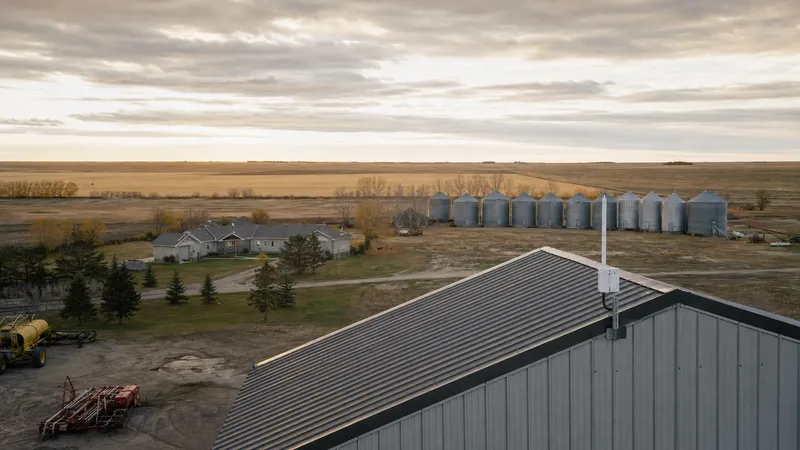
Prairie grain operation: bins spread across a half-mile yard. This is where placement starts to matter. A half-mile is roughly 800 metres end to end. With a gateway mounted on the shop roof or on a short tower near the centre of the yard, you can reasonably expect to cover all bins with usable signal, but margins to the furthest bins will be thinner. Things to watch for: bins clustered behind a taller bin or a leg can sit in a radio shadow, and a gateway placed off to one side of the yard will struggle to reach the bins at the opposite end. Many large grain operations end up either moving the gateway to a more central, taller location, or adding a second gateway near the far end of the yard. A second gateway in a half-mile yard can be a reasonable choice depending on radio shadows from clustered bins, gateway mounting height, and how close to the margins your furthest sensors are sitting. Plenty of similar yards run fine on one well-placed gateway.
Ontario fruit or vegetable farm: several outbuildings and a packing facility. This layout is harder than it looks because the structures usually include refrigeration, a packing house, multiple outbuildings, and often a treed lane or shelterbelts between them. Distances are usually shorter than a prairie yard, but the obstacle density is higher. A single gateway mounted on the packing facility (often the tallest building on these operations) tends to be the natural choice, since that is where you most need reliable monitoring anyway. Cold room sensors will usually still report through the insulated walls, but at reduced range. Sensors out at distant outbuildings or pump houses past a shelterbelt may need either a tactical gateway move (higher mount, different building) or a second gateway. Operators who try to put the gateway inside the packing house, surrounded by metal and refrigeration units, often regret it.
Common gateway placement mistakes
Most LoRaWAN disappointment on farms traces back to one of a small set of choices that seemed reasonable at install time.
Mounting the gateway indoors at desk height. A gateway sitting on a shelf in the farm office, surrounded by walls, will work for sensors in the same building and almost nothing else. The fix is height and an external antenna, not a stronger gateway.
Putting the gateway in the middle of the metal. Inside a steel-clad shop, inside a packing house, or up against a cold room wall, the gateway is fighting through its own building before it reaches anything else. Outside-mount or roof-peak placement performs much better.
Trusting one gateway for very long yards. A single gateway can absolutely cover a half-mile or larger yard, but only if it is well placed and high. If sensors at the far end of the property are intermittent, adding a second gateway is usually cheaper than fighting placement for months.
Ignoring shelterbelts and tree lines. A row of mature trees between gateway and sensors will quietly eat several decibels of signal margin, especially when leafed out. If you have a treed lane between the farmhouse and a remote pump house, plan accordingly.
A practical placement checklist
If you are setting up a new system, a few steps go a long way before you commit to permanent mounts.
- Walk the property and identify your highest reasonable mounting point. Roof peaks, grain leg platforms, hay shed gables, and short antenna masts all work.
- List every sensor location and roughly measure or pace the distance from each one to your candidate gateway spot.
- Note any obstacles between each sensor and the gateway: bins, shelterbelts, terrain rises, refrigerated buildings.
- Start with one gateway in the most central, tallest location you reasonably can. Most installations actually work fine with one.
- Test before you finalize. Install a sensor at the furthest planned location and confirm it reports cleanly for a week. If it does not, move the gateway higher or add a second one.
LoRaWAN is genuinely good at covering a farm. It is also genuinely sensitive to where you put the gateway. Spend half a day on placement up front and the system will largely take care of itself, with periodic check-ins to account for the things that change over time: shelterbelt growth, new outbuildings, relocated equipment, seasonal foliage, and the occasional sensor that drifts as the property evolves. A quick coverage review once or twice a year is usually all it takes to keep things healthy.
Storage Sentry is a wireless monitoring platform purpose-built for Canadian agricultural operations, helping support growers with LoRaWAN-based temperature, humidity, and water monitoring across multi-building farms. See how Storage Sentry can help cover your operation.
References
- The Things Network. "LoRaWAN: Distance to Gateway." thethingsnetwork.org
- Innovation, Science and Economic Development Canada. "RSS-247 Digital Transmission Systems, Frequency Hopping Systems and Licence-Exempt Local Area Network Devices." ic.gc.ca
- LoRa Alliance. "What is LoRaWAN Specification." lora-alliance.org