The Most Critical Greenhouse Environmental Factor: How CO2, Humidity, and Temperature Work Together
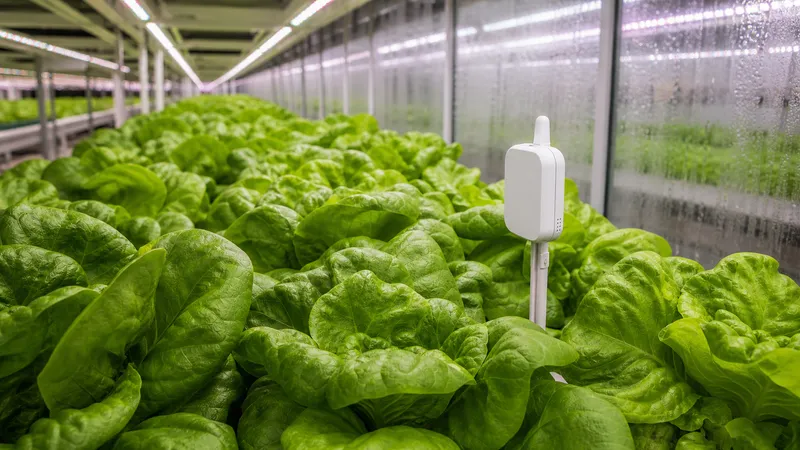
If you grow indoors at scale, whether that is mushrooms in a Quebec block house, leafy greens on a vertical farm in Ontario, herbs under LED in BC, or tomatoes and cucumbers in a Leamington glass range, the three variables that decide your day are CO2, humidity, and temperature. They are not independent dials. They are three readings of the same physiology happening in your canopy, and the way they move relative to each other tells you more than any single number ever will.
This article is for Canadian commercial growers who run climate-controlled production rooms or greenhouses and want to get more out of the sensor data they already collect. It covers the physiology that ties the three variables together, where single-variable monitoring quietly fails, and the alert combinations that turn a dashboard into a useful early warning system. It is a companion to year-round greenhouse climate monitoring and the more strategic work of using sensor data without guesswork.
What Is the Most Critical Environmental Factor in Greenhouse Plant Production?
Temperature is the most critical environmental factor in greenhouse plant production because it sets the plant's metabolic speed and determines how humidity, VPD, and CO2 actually affect growth. If the canopy is too cold or too hot, added CO2 cannot be used efficiently and humidity targets stop describing what the plant is experiencing, which is why temperature sits at the centre of year-round greenhouse climate control. The practical answer is to manage temperature together with CO2 and humidity, then use sensor data to optimize growing conditions instead of treating each reading as a separate alarm.
The three variables are one conversation
Plants run two processes that depend on all three readings at once.
Photosynthesis takes CO2 from the air and uses light energy to fix it into sugars. The rate of carbon fixation depends on how much CO2 is available, how much usable light reaches the leaf, and whether leaf temperature sits in the productive range for the crop. Push CO2 up to 1,000 ppm in a room that is too cool, or too dim, or too hot, and the plant cannot use the extra carbon. The CO2 cost is wasted.
Transpiration moves water from the root zone, through the plant, and out through stomata in the leaves. It cools the leaf, drives nutrient uptake, and only happens at the rate the air around the leaf will accept water. That rate is controlled by vapour pressure deficit, or VPD, which is a function of both temperature and relative humidity. Two rooms at 70 percent humidity behave very differently if one is at 18 degrees Celsius and the other is at 26. The cooler room holds less moisture in absolute terms, the VPD is lower, and transpiration slows. The plant takes up less calcium, stomata stay more open than they should, and disease pressure climbs.
This is the crux of the matter. CO2 controls how much carbon the plant can fix. Temperature sets the metabolic speed. Humidity, paired with temperature through VPD, controls how the plant moves water and takes up nutrients. A change in any one of them shifts the other two in the plant's response. If your monitoring treats them as separate alarms, you are watching three instruments and missing the song.
Why a single-variable alert misses the real problem
A standard single-variable alert fires when one number crosses a threshold. Temperature above 26. Humidity above 85. CO2 above 1,500. Useful as a backstop, limited as a diagnostic.
Failures in a growing room rarely look like one number crossing a threshold. They look like two or three numbers moving together in a pattern. A few examples.
A tomato house running 75 percent humidity at 18 degrees overnight sits at a VPD that is too low for healthy transpiration, even though the humidity reading alone looks acceptable. The same 75 percent at 24 degrees during the day is in a productive VPD range. A humidity-only alert treats the two situations identically. The plants do not, and the difference shows up in calcium-related disorders like blossom-end rot and in fungal pressure that builds while the bulk humidity number looks fine.
A vertical leafy greens room dosing CO2 to 900 ppm under full LED can run a steady CO2 reading all morning. If room temperature drifts up two degrees above the crop's productive range because the chiller is cycling slow, photosynthesis efficiency drops, the crop responds with weaker turgor and softer texture at harvest, and no single alert fires the whole time.
A glass house dosing CO2 in the morning may show a steady drop in CO2 from 1,200 ppm down toward ambient. That is normal if the vents have opened to shed afternoon heat. It is a real problem if the vents are still closed and the CO2 is dropping because plants are fixing carbon faster than the dosing system is replacing it, which means you are about to undershoot your target during the most productive part of the day.
Alert combinations that actually mean something
Treat the specific numbers below as starting points to tune against your own crop, structure, and recipe.
CO2 falling while temperature rising. Ventilation has kicked in. On a sunny day this is expected behaviour. If it happens overnight or during the dosing window when vents should be closed, it usually means a vent has opened in response to a heat call that should have been handled by the heating side, or that a wall fan is running when it should not be. Either way, you are venting expensive CO2 to the outside.
CO2 climbing while humidity climbing. Ventilation has failed or is undersized for current conditions. Plants and any combustion-based CO2 source are loading the air faster than the air is being exchanged. If this pattern shows up for more than 30 to 60 minutes, check exhaust fans, vent positions, and whether a damper is stuck. In a sealed room, this is also the early signature of a CO2 generator that is overshooting its setpoint.
Temperature stable while humidity climbing. Transpiration is happening but moisture is not being removed. This is common in shoulder seasons when the heating system is barely cycling and dehumidification depends on heat-and-vent. It is a leading indicator for Botrytis and downy mildew pressure in fruiting vegetable crops, particularly when sustained for several hours, combined with leaf wetness, or hitting a susceptible crop stage. The fix is usually a forced dehumidification cycle or more aggressive air movement, not waiting for the humidity number alone to cross a hard threshold.
Humidity falling while temperature climbing. Either the heating system is overshooting and drying the air, or a vent has opened on a cold dry day. The combination pushes VPD high, which stresses sensitive crops and can desiccate cuttings and seedlings in a propagation area inside an hour.
CO2 stable, temperature stable, humidity drifting up overnight. Often a sign that horizontal airflow has stopped in part of the room. Bulk readings look fine while a corner of the canopy sits in stagnant moist air, where VPD collapses at the leaf surface and disease pressure builds long before any room average crosses a threshold.
CO2 dropping during dosing hours with no ventilation activity. Your CO2 supply has stopped. A liquid system has run out, a generator has shut down on a fault, or a regulator has frozen. The crop will not show stress immediately, but the missed productivity adds up by the end of the week.
Where you put the sensor matters as much as the alert
A reading from the wrong place tells you about a part of the room the plants are not in. The most common mistake in retrofits is placing sensors high on a wall or near the ceiling because that is where the conduit already runs.
Canopy level, not roof. Temperature stratifies in any room with a vertical dimension, and the difference between 2 metres up and the top of the canopy can be 3 to 5 degrees Celsius in a glass house on a sunny morning. Canopy boundary layers can be more humid than roof or return-air readings, especially with poor air movement. A roof-level sensor underreports humidity at the leaf and overreports temperature relative to where transpiration is actually happening.
Shielded from direct light and irrigation spray. A sensor in direct sun reads its own enclosure temperature, not the air. A sensor that gets wet during overhead irrigation reads 100 percent humidity for an hour after every cycle and drifts faster than a dry sensor.
Distributed across zones. One sensor for a 1,000 square metre room is one data point. Cold pockets and hot spots only show up when you can compare readings across the room, especially when the sensor network is planned with real-world LoRaWAN range in mind.
CO2 sensors near the plant, not in the return air. A return-air CO2 reading tells you what the room average looks like after mixing. A canopy CO2 reading tells you what the leaf is actually seeing during the dosing window, which is the number that drives carbon fixation.
What to do next
If you already log the three variables, the next practical step is to set up combination alerts rather than only individual thresholds. Start with two patterns: CO2 climbing with humidity climbing, and temperature stable with humidity climbing. Those two cover the most common failure modes in commercial Canadian growing rooms.
From there, walk each zone with a calibrated handheld and compare readings to your fixed sensors at canopy level. If the difference is more than a degree on temperature or 5 percent on humidity, your monitoring is telling you about a sensor location problem before it can tell you anything useful about the crop.
The growers who get the most out of environmental monitoring are not the ones with the most sensors. They are the ones whose sensors are in the right places and whose alerts describe relationships, not just numbers.
Storage Sentry is a wireless monitoring platform purpose-built for Canadian agricultural operations, helping indoor growers track CO2, humidity, and temperature across every zone with combination alerts that catch what single-variable thresholds miss. Learn how Storage Sentry can help.
References
-
Ontario Ministry of Agriculture, Food and Rural Affairs. "Greenhouse Vegetable Production Recommendations (Publication 371)." omafra.gov.on.ca
-
Agriculture and Agri-Food Canada. "Crop Profile for Mushroom Production in Canada." agriculture.canada.ca
-
British Columbia Ministry of Agriculture and Food. "Greenhouse Vegetable Production Guide." gov.bc.ca