Flow Rate and Pressure Monitoring: Keeping Your Wash Line Running
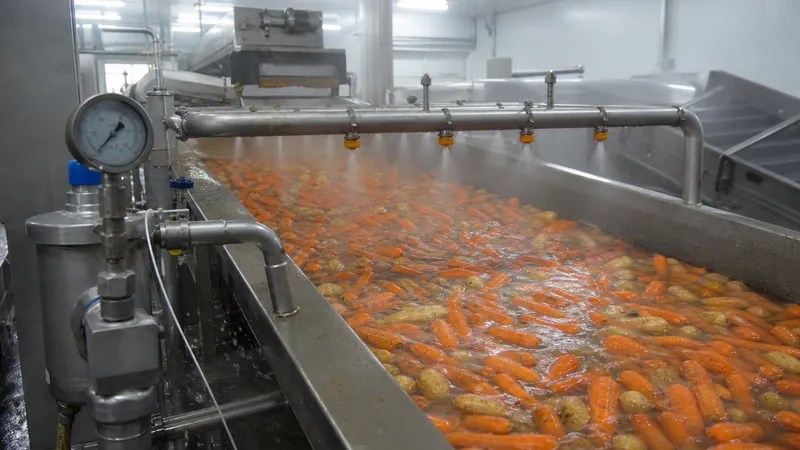
A wash line is one of the busiest pieces of equipment in a packing facility. Thousands of pounds of carrots, potatoes, leafy greens, or root vegetables move through it every shift, and the water doing the work has to arrive at the right flow rate and the right pressure to actually clean the product. When either one drifts, the product quality drops, the food safety risk climbs, and nobody on the line tends to notice until the damage is already done.
This article is for produce washing and packing operators who run flume tanks, brush washers, spray bars, and rinse lines. It walks through what flow rate and pressure actually do for you, what tends to go wrong, why relying on the line tender to "just notice" is not a real strategy, and what good monitoring looks like. It is the setup companion to what happens when a wash line pump fails, and it connects to the broader packing facility monitoring environment.
Note: this is a practical overview, not legal or engineering advice. Specific thresholds for your line depend on the equipment, the commodity, and your facility's Preventive Control Plan.
What flow rate and pressure actually do on a wash line
A wash line uses water to do three jobs at once: physically move debris off the product, dilute contamination so it cannot re-deposit, and deliver sanitizer at the intended concentration across the product. Flow rate and pressure both feed into all three. They can also affect sanitizer contact time, though the main determinants there are dwell time, conveyor speed, line geometry, product loading, and sanitizer concentration.
Flow rate, usually measured in litres per minute or gallons per minute, controls how much water passes over the product. Too low and you do not have enough volume to actually carry soil and debris away. Too high and you can damage delicate product, push it through the line too fast for proper sanitizer contact, or overload the wastewater system.
Pressure does a slightly different job. On spray bars and nozzles, line pressure determines whether the spray pattern is correct. A nozzle rated for 40 PSI produces a fan-shaped spray that covers the conveyor evenly. Drop that to 15 PSI and the spray collapses into a dribble that hits the same spot every time, leaving most of the product untouched. Push it to 80 PSI and you can bruise leafy greens or strip skin off new potatoes.
Get either one wrong and the line keeps running. The product still moves down the belt, the workers still pack it, and the shift still ends on time. The issue is what happens next, when buyers reject loads, shelf life drops, or a routine swab finds something that should not be there.
Why operators miss flow and pressure problems
Most wash line problems are not catastrophic. A pump does not seize. A line does not burst. Things drift slowly, and slow drift is exactly what humans are bad at noticing.
The line tender watches the product, the conveyor speed, and the workers around them. They are not staring at a flow meter. Even on lines that have a flow meter mounted somewhere, it is often a mechanical paddle wheel gauge tucked behind a pump skid, readable only if you walk over and squat down. Pressure gauges on supply lines fare a little better, but they are also usually out of the operator's normal sight line.
The end of shift is when problems get caught, which is the worst possible time. By then, eight hours of product has gone through under-spec wash conditions. If the load is rejected, that is real money. If it gets shipped and a customer complaint comes back two weeks later, the consequences extend further.
Common failure modes on wash lines
Wash systems fail in fairly predictable ways. Knowing what to look for helps explain why continuous monitoring catches problems hours earlier than spot-checks.
Pump cavitation. When suction pressure at a centrifugal pump falls below the water's vapour pressure, vapour bubbles form and then collapse violently as they reach higher-pressure regions inside the impeller. Flow drops, pressure becomes erratic, and the pump itself starts to wear quickly. Cavitation usually starts from a clogged inlet strainer, a partially closed valve, or a drop in the supply tank level. Air entrainment from a leaking suction joint or a low tank vortex is a related but distinct problem with similar symptoms. The signature on a flow meter is a wobbly, declining trend rather than a clean drop.
Clogged filters and strainers. Wash water carries soil, leaf matter, sand, and small stones. Pre-filters trap that material, which is exactly what they are supposed to do, but they need to be cleaned. A filter that is 80% blocked produces a steady pressure drop downstream and a steady flow decline. Operators who clean filters on a fixed schedule miss the days when the field came in muddier than usual.
Failed or stuck valves. A solenoid valve that fails partially open, a butterfly valve that vibrates loose, or a check valve that sticks all change the flow split between sections of the line. Often one zone ends up under-pressured while another runs higher than intended.
Nozzle wear and blockage. Spray nozzles are consumables. They wear out, they plug with debris, and they occasionally snap off entirely. A single blocked nozzle is hard to see from a distance, but on many fixed-speed systems it shows up on a pressure transducer as a small upward drift, since the remaining nozzles are now passing less total flow at the same pump output.
Line breaks and leaks. A hose split or a fitting that lets go produces an obvious pressure drop, but only if anyone is watching. On a line with no pressure alarm, a leak behind a guard or under a deck plate can run for an entire shift before anyone notices the puddle.
Supply tank issues. Wash systems usually draw from a buffer tank that refills from municipal supply or a well. If the float valve sticks, the fill rate cannot keep up with draw, or the supply line itself loses pressure, the tank level drops. Eventually the pump starts pulling air and cavitation begins.
What you can actually monitor
You do not need to instrument every pipe to get useful coverage. A small number of well-placed sensors gives you most of the signal.
Inline flow meters on the main supply. A flow meter on the line feeding the wash system tells you how much water you are using per minute. Magnetic flow meters work well because they have no moving parts to clog or wear. Set normal-range alerts and you catch pump issues, filter blockages, and supply problems in one place.
Pressure transducers at meaningful points. A transducer on the supply side of the spray bars tells you whether nozzles are getting the pressure they need. The other points worth instrumenting are the recirculation return, the differential across the main filter, and pump suction or discharge. Together those readings help you distinguish between an inlet problem, a filter problem, and a downstream issue. Pressure data is cheap to collect and almost always the first thing to show a developing issue.
Tank level sensors. A simple level sensor on the buffer tank prevents the cascade where a low tank causes cavitation that damages the pump. It is also useful for water-use records.
Sanitizer concentration probes. Inline ORP or free chlorine probes track sanitizer levels continuously. Concentration that drifts low is a food safety concern. If your facility uses chlorinated wash water, CFIA guidance generally recommends recording chlorine concentration, pH, temperature, and contact time as part of your preventive control plan, and continuous data makes that recordkeeping much easier.
Water temperature. Wash water temperature affects both sanitizer efficacy and product condition. A temperature sensor on the supply costs almost nothing to add and rounds out the picture.
The food safety angle
Under the Safe Food for Canadians Regulations, most relevant food businesses need preventive controls, and many are required to have a written Preventive Control Plan, though specific duties depend on the activity and the size of the business. For licensed operators who wash produce, wash water quality is generally one of the control points the plan covers. Inspectors typically expect to see records showing that monitored parameters stayed within the limits set out in the PCP. For chlorinated wash water, those records usually centre on chlorine concentration, pH, water temperature, and contact time. Flow rate may be tracked as part of facility-specific controls, but it is not by itself a typical regulatory record.
Monitoring systems that log this data continuously make this easier in two ways. The records are generated automatically, so nobody has to remember to fill in a log sheet. And when an inspector asks for verification, you can show the data for the entire shift rather than a handful of spot-checks. The logs support compliance records and demonstrate that monitored parameters stayed in range; they do not on their own prove microbiological efficacy. For a closer look at that records tradeoff, see manual temperature logs vs automated monitoring.
The alternative, finding out at end-of-shift that flow was below spec for six hours, is not a position any operator wants to be in. Depending on the situation, the options range from holding product and assessing records, to rewashing where appropriate, to investigating per the PCP, to rejecting the affected pack outright.
What good monitoring looks like
A practical monitoring setup for a small to mid-sized wash line shares a few characteristics. Sensors report continuously to a central platform a supervisor can see on a phone or office screen, not a panel three rooms away. Alerts go by text or email to people who can act on them, with thresholds tight enough to catch drift early but wide enough to avoid nuisance alarms on start-up. Data is retained long enough to support traceability and inspection, and trend views surface a gradually clogging filter or a fading pump before either takes a shift down.
You do not need a perfect system on day one. Even a single flow meter and a single pressure transducer, alerting to a supervisor's phone, will catch the majority of common failure modes. The point is to stop relying on the line tender's peripheral vision as the primary detection method.
Practical next steps
If you are running a wash line without continuous monitoring, walk the line with a notebook and pick two sensor locations: one flow meter on the main supply and one pressure transducer near the spray bars. Decide what alert level would catch a real problem before it ruins a shift. From there, the question is whether to install a stand-alone gauge with a local alarm or a connected sensor that pages whoever is on call and keeps the record automatically. For most facilities the connected option earns its keep on the first prevented bad shift.
Storage Sentry is a wireless monitoring platform purpose-built for Canadian agricultural operations. It connects sensors on your wash line, cold storage, and packing facility to alerts and records you can actually use, helping support food safety and consistent product quality. Learn how Storage Sentry can help.
References
-
Canadian Food Inspection Agency. "Guide for Preparing a Preventive Control Plan." inspection.canada.ca
-
Canadian Food Inspection Agency. "Preventive Control Plans: Record Keeping." inspection.canada.ca
-
Canadian Food Inspection Agency. "Safe Food for Canadians Regulations." inspection.canada.ca