Cold Chain Integrity for Canadian Produce: From Harvest to Storage
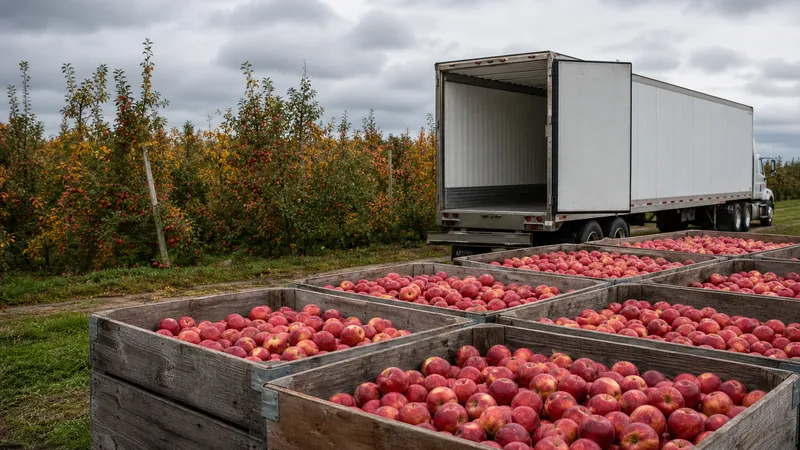
If you grow, pack, or store fresh produce in Canada, the value of your crop drops every hour it spends above its target temperature. That is true whether you run an apple operation in the Annapolis Valley, a tender fruit packing shed on the Niagara peninsula, a tree fruit cooperative in the Okanagan, or a root vegetable storage in Manitoba. The cold chain is the system that protects that value from the field to the customer, and like any chain, it is only as strong as its weakest link.
This article walks through how the produce cold chain works stage by stage, where Canadian operations most often see it break down, and what is worth monitoring at each step. It is written for growers and packers who want to think practically about shelf life, quality, and the records that back both up. The same cold-room decisions also show up in walk-in cooler failure prevention, after-hours compressor monitoring, and effective temperature alert thresholds.
Note: This is a practical overview, not legal or food safety advice. Specific requirements vary by commodity, regulated activity, and trade model. For obligations under the Safe Food for Canadians Regulations or provincial food safety rules, consult the CFIA, your provincial ministry, or a qualified food safety professional.
Why cold chain quality is cumulative
A common mental model is that produce arrives at the customer in good shape if the cooler at the end is set correctly. That model costs Canadian growers real money every year.
Shelf life is cumulative: every warm hour counts. Every hour spent above the target uses up reserves that the produce never gets back. A pallet of strawberries that sat in the sun for four hours after picking can look fine when it hits a 1°C cooler that afternoon, but its remaining shelf life is materially shorter than a pallet cooled within the first hour. Provincial extension services consistently emphasize speed of cooling, not just final storage temperature.
Stage one: removing field heat
Most produce leaves the field at 15°C to 30°C depending on the crop and the time of day. Getting that down to the commodity's storage temperature quickly is the single highest-impact step in the cold chain. There are three main methods used in Canadian operations.
Forced-air cooling. Pallets are placed in a chamber and cold air is pulled through the boxes by a fan and tarp arrangement. This is the workhorse method for apples, pears, stone fruit, peppers, and many berries. It is slower than hydrocooling but works for many packed commodities. Field heat removal can take from one hour for berries up to a full day for bulk apples in bins.
Hydrocooling. Cold water is showered or immersed over the product. It is fast and very effective for commodities that tolerate water, such as sweet corn, radishes, carrots, broccoli, and some leafy greens. It is not appropriate for product that bruises easily or that does not tolerate surface moisture, like raspberries.
Vacuum cooling. Lowering the pressure around the product causes water to evaporate from the surface, which removes heat. It is commonly used for leafy greens and similar high-respiration vegetables such as iceberg lettuce, romaine, and cauliflower. Vacuum cooling can bring a pallet of lettuce from 25°C to 2°C in around 30 minutes.
Where this stage fails is usually incomplete removal. A forced-air room that is overloaded, or one where pallets are not arranged to let air flow through the boxes, may bring the surface temperature down quickly while the core stays warm. A core temperature check, not just an ambient room reading, is the only way to know whether field heat is actually gone.
Stage two: storage at the right temperature and humidity
Every commodity has a fairly narrow band where it stores best. Generic guidance from OMAFRA, the BC Ministry of Agriculture, and similar extension resources gives reasonable starting points.
Apples and pears. Around 0°C with 90 to 95 percent relative humidity. Controlled atmosphere storage, used widely by BC and Ontario apple operations, extends this further by lowering oxygen and raising carbon dioxide.
Leafy greens, broccoli, sweet corn. Around 0 to 2°C with very high humidity, usually 95 percent or above. These crops respire quickly and lose quality within days if held warmer.
Berries. Around 0°C with 90 to 95 percent humidity, with the additional requirement of getting there fast.
Tomatoes, peppers, cucumbers. Warmer than most growers expect, generally 10 to 13°C depending on maturity and crop. Holding tomatoes below about 10°C causes chilling injury that shows up later as mealy texture, pitting, and accelerated decay.
Potatoes. Cool curing for one to two weeks at around 12 to 15°C with high humidity, then long-term storage at 3 to 4°C for table stock and warmer for processing potatoes. Prairie root vegetable operations live and die on getting these curves right.
Onions and garlic. Cool and dry. Around 0°C with 65 to 70 percent humidity. The opposite of leafy greens, which is why mixed-commodity storage is so difficult.
Temperature drift over a long storage season is one of the quieter failure modes. A cooler that holds 1°C for the first month but creeps to 3°C by month six does not look like a failure on any single day, yet that drift can shave weeks off a crop's marketable life. Continuous logging is what makes drift visible.
Stage three: transport
Reefer trailers, sea containers, and air freight units are designed to hold a setpoint, not to remove heat. If product is loaded warm, a reefer will struggle to bring it down, especially with a full load.
The breakdowns at this stage are usually procedural rather than mechanical.
Doors propped open at receiving. A reefer pulled up to a dock with the doors open for 20 minutes can lose much of its temperature stability, particularly in summer. Strip curtains, fast unloading, and refrigerated docks help.
Mixed loads with incompatible commodities. Apples produce ethylene, and ethylene-sensitive crops like lettuce, broccoli, and other leafy greens age faster when stored or shipped alongside them. Putting lettuce and apples on the same load shortens the lettuce's life noticeably. Carriers who consolidate freight do not always know this.
Setpoint versus actual. A reefer set to 2°C does not guarantee 2°C in every part of the trailer. Top of load, front bulkhead, and area near the door can vary by several degrees. Portable data loggers placed in those positions reveal what the reefer thermometer alone does not.
Stage four: receiving, ripening, and retail
Most Canadian growers and packers hand off to a customer or distributor at some point, but records may still matter in buyer, audit, insurance, or investigation contexts. Records that show the product left in spec are an asset.
At the receiving end, common breakdowns include holding pallets on a warm dock before they are put away, breaking down loads in non-refrigerated rooms, and tomato or banana ripening rooms that are not properly separated from cold storage.
Practical steps to tighten your cold chain
You do not need to redesign your operation to make meaningful gains. A few focused actions cover most of the risk.
Map your critical control points. For each commodity, write down where temperature matters most. That usually means the cooling stage, the main storage room, the loading dock, and any ripening or curing rooms.
Measure core temperature, not just air temperature. A probe inserted into a piece of fruit or a clamshell tells you what the room sensor cannot. This is especially important when verifying that field heat is gone.
Separate ethylene producers from ethylene-sensitive crops. If you cannot dedicate rooms, at least schedule storage so that conflicting commodities are not held together for long periods.
Log continuously and retain the records. Where manual logs are accepted, they still need to be complete, retrievable, and retained for the required period, and two years of complete manual logs is hard to deliver. Continuous wireless sensors with cloud logging close that gap and create the time-stamped record that buyers, inspectors, and insurers actually want to see.
Audit your reefer practices. Talk to your carriers about loading temperature requirements, door times at the dock, and whether they will share trip data. Place independent data loggers on shipments occasionally to verify what you are being told.
The cold chain is not glamorous work. It is small habits and quiet equipment doing their job for weeks on end. When it works, your produce arrives the way you intended, your records support whatever audit comes next, and your conversations with customers are about future business rather than yesterday's claim.
Storage Sentry is a wireless monitoring platform purpose-built for Canadian agricultural operations, helping support produce operations with continuous, time-stamped temperature and humidity records across cooling rooms, long-term storage, and loading areas. Learn how Storage Sentry can help.
References
-
Canadian Food Inspection Agency. "Preventive control plan for food businesses: Record keeping." inspection.canada.ca
-
Ontario Ministry of Agriculture, Food and Agribusiness. "Postharvest Cooling and Handling of Apples." omafra.gov.on.ca
-
Ontario Ministry of Agriculture, Food and Agribusiness. "Postharvest Handling of Horticultural Crops (Publication 839)." omafra.gov.on.ca
-
British Columbia Ministry of Agriculture and Food. "Tree Fruit and Berry Production Resources." gov.bc.ca
-
Canadian Horticultural Council. "Food Safety and Traceability." hortcouncil.ca
-
United States Department of Agriculture. "The Commercial Storage of Fruits, Vegetables, and Florist and Nursery Stocks (Agriculture Handbook 66)." ars.usda.gov