Air Quality Monitoring for Poultry and Swine Operations
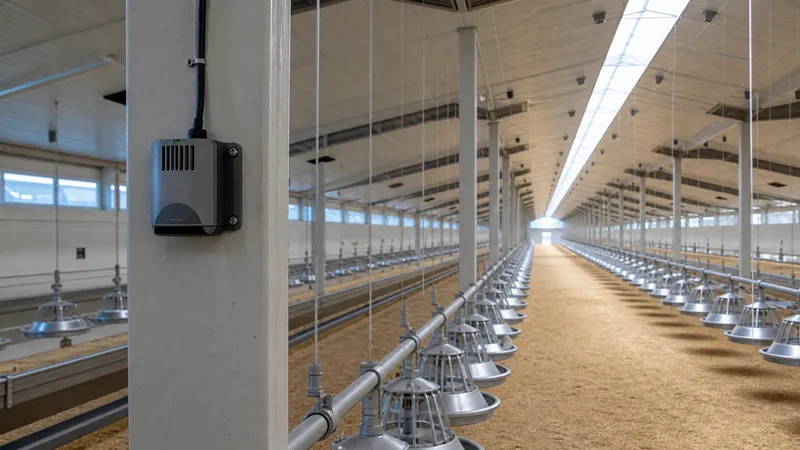
Most producers think about air quality through the lens of ventilation. The fans run, the inlets open, the temperature stays in range, and the assumption is that the air is fine. In practice, airflow and air quality are related but not the same thing. A barn can be moving plenty of air and still have ammonia at animal level high enough to damage respiratory tissue, carbon dioxide creeping up during a cold-weather minimum-ventilation cycle, or hydrogen sulfide spiking dangerously during manure agitation.
This article is for Canadian poultry and swine producers, barn managers, and farm staff who want a clearer picture of what their air quality monitoring should actually measure, where the sensors belong, and how the readings tie back to animal welfare and worker safety. The focus is on the three gases that come up most often in welfare and safety conversations: ammonia, carbon dioxide, and hydrogen sulfide. If you already monitor temperature and humidity, gas sensing is the next logical layer, especially alongside livestock barn ventilation monitoring.
Note: This is operational guidance, not legal, veterinary, or compliance advice. Animal welfare expectations and worker safety regulations vary by province and by operation type. Consult provincial occupational health and safety authorities, your veterinarian, and the relevant NFACC Code of Practice for guidance specific to your situation.
The three gases that matter most
Different gases have different sources, different effects, and different acceptable ranges. A monitoring program that treats them all the same misses the point of having sensors in the first place.
Ammonia (NH3). Ammonia is generated when nitrogen in urine and manure breaks down, particularly when bedding is wet or manure storage is close to the animals. It irritates the respiratory tract and the eyes at concentrations that are not high enough to be obvious to the human nose. The NFACC poultry and layer Codes of Practice identify action being required in the 20 to 25 ppm range at bird level, and the pig Code references keeping ammonia below 25 ppm at pig level, so 25 ppm is best treated as a common action threshold rather than a universal welfare target. Chronic exposure even in the 20 to 25 ppm range is associated with reduced performance and increased respiratory disease, and producers aiming for higher welfare standards often target below 10 ppm.
Carbon dioxide (CO2). Carbon dioxide is produced by animal respiration and, in barns with fuel-fired heaters, by combustion. Outdoor air sits around 420 ppm. Indoor levels in a working barn are always higher than that, and the question is how much higher. As a general welfare reference, levels are typically kept below 3,000 ppm during normal operation, with sustained readings above 5,000 ppm treated as a sign that ventilation is undersized for the current load. CO2 is most likely to become a problem in winter, when minimum ventilation rates are tuned to retain heat and the air exchange falls below what the stocking density actually requires.
Hydrogen sulfide (H2S). Hydrogen sulfide is the dangerous one. It is produced in liquid manure systems, particularly during agitation before pump-out, and it can rise from pit access points faster than anyone in the room can react. At low concentrations it smells like rotten eggs. At concentrations that threaten human life, it deadens the sense of smell, which is exactly the wrong feedback at the worst possible moment. Canadian provincial occupational exposure limits for H2S typically sit around 10 ppm as an eight-hour average, with short-term limits commonly around 15 ppm, but specific numbers vary by jurisdiction. Acute exposures well above those levels can be fatal within minutes.
Ammonia tracks the long-term health of the barn environment. Carbon dioxide tracks whether ventilation is matching the current biological load. Hydrogen sulfide is primarily a worker safety question and a welfare concern during manure handling.
Why ventilation monitoring alone misses gas issues
A common assumption is that a properly running ventilation system produces acceptable air quality by definition. That assumption holds in many situations, but it breaks in several specific cases that come up regularly on Canadian operations.
Cold-weather minimum ventilation is the most common one. In winter, ventilation rates are deliberately reduced to retain heat and conserve propane. The fans are running, static pressure is within range, and the controller reports normal operation, but carbon dioxide and ammonia can climb anyway because the air exchange is too low for the stocking density. The system is doing exactly what it was set to do, and the air is still bad.
Wet bedding is another. A barn with wet litter or a leaking nipple line produces ammonia faster than the ventilation can clear it at animal level, even with strong airflow overall. Manure pit agitation is the third. Hydrogen sulfide release during agitation is a chemistry problem that ventilation has to deal with after the fact, and the only way to know whether the response is adequate is to measure the gas directly.
Ventilation monitoring tells you whether the system is running. Gas monitoring tells you whether the system is enough.
What sensors actually measure each gas
Not all gas sensors work the same way, and the technology matters because it affects accuracy, drift, lifespan, and what you can reasonably expect from a sensor over a multi-year deployment in a barn environment.
Electrochemical sensors for NH3 and H2S. Ammonia and hydrogen sulfide are typically measured with electrochemical cells. These sensors produce a small current proportional to the gas concentration at the cell. They are reasonably accurate, relatively inexpensive, and well suited to barn environments. The trade-off is that the cells age and drift over time, and most have a usable life of one to two years before calibration drift becomes significant. Plan for periodic replacement rather than expecting indefinite accuracy.
NDIR sensors for CO2. Carbon dioxide is best measured with non-dispersive infrared sensors, which measure how much infrared light a sample of air absorbs at the wavelength CO2 absorbs. NDIR sensors are stable over long periods, are not consumed by the gas they measure, and hold calibration well. They generally have a longer useful life than electrochemical cells, which matters for both budgeting and maintenance planning.
Where to place sensors
Placement determines whether the readings reflect what the animals and workers actually breathe. The wrong location can make a barn look fine on the dashboard while conditions on the ground are not.
For ammonia in poultry, the sensor belongs at bird level, which means low to the floor and out of the direct path of inlet jets or fan exhaust. Mounting an ammonia sensor at human height in the centre of the room consistently under-reads what the birds are exposed to. In swine, a similar principle applies, with the sensor placed in the animal occupancy zone rather than at ceiling height.
For carbon dioxide, mid-room placement at roughly animal head height works well in most configurations. CO2 distributes more evenly than ammonia, so exact placement is less critical, but avoid mounting directly beside an inlet where fresh air dilutes the reading.
For hydrogen sulfide, place at least one monitor near pit access points and at human breathing height, particularly in rooms with deep-pit manure storage or pull-plug systems. A second monitor in the main work area provides additional warning. The goal is to alert anyone entering the room before they walk into a concentration that has already incapacitated their sense of smell. Fixed room-mounted monitors near pit access are useful, but worker safety should not rely on them alone. During manure agitation, pump-out, or any confined-space-style work near pits, staff should also wear personal gas monitors, which travel with the worker and respond to the concentration at their breathing zone rather than across the room.
If you only have budget for partial coverage, prioritize ammonia at animal level in each ventilation zone, and H2S near pit access points in any swine room with liquid manure storage. Add CO2 as a winter-priority sensor in tightly stocked rooms.
Practical alert thresholds
Thresholds should reflect both welfare targets and the response time you actually have. Pre-alarm levels give staff a chance to investigate before conditions become critical.
A reasonable starting point for many operations: ammonia warning at 20 ppm and critical at 25 ppm, evaluated as a sustained reading rather than a single spike. Carbon dioxide warning at 3,000 ppm and critical at 5,000 ppm, again as a sustained reading. Hydrogen sulfide is different and should be treated as a safety alarm rather than a welfare metric. Any sustained reading above the provincial occupational exposure limit during normal operation, or a sharp rise during agitation, warrants immediate attention. Pair the alert with a clear evacuation protocol for the room.
Adjust these numbers for your species, your stocking density, and any specific welfare program you participate in. The thresholds above are conservative defaults, not regulatory floors.
Where this fits in the overall monitoring layer
Gas monitoring sits alongside temperature, humidity, and power-loss monitoring rather than replacing any of them. Temperature failures move faster than gas excursions in most scenarios, so they remain the priority alert. Gas sensors add the missing dimension: whether the barn is a healthy environment when the climate system is working as intended, and they add a layer of worker protection that no temperature sensor can provide. For a plain-language overview of the same monitoring basics, see understanding facility monitoring.
Most operations do not need every gas measured in every room. They need ammonia at animal level where welfare matters most, CO2 where winter ventilation is tight, and H2S anywhere workers might walk into a manure-handling hazard. Start there, and expand coverage based on what your specific operation actually needs.
Storage Sentry is a wireless monitoring platform purpose-built for Canadian agricultural operations, helping support poultry and swine producers with independent temperature, humidity, and gas monitoring that runs alongside existing barn controllers and sends redundant alerts when readings move out of range. Learn how Storage Sentry can help.
References
- National Farm Animal Care Council. "Code of Practice for the Care and Handling of Hatching Eggs, Breeders, Chickens, and Turkeys." nfacc.ca/poultry-code-of-practice
- National Farm Animal Care Council. "Code of Practice for the Care and Handling of Pullets and Laying Hens." nfacc.ca/poultry-layers-code-of-practice
- National Farm Animal Care Council. "Code of Practice for the Care and Handling of Pigs." nfacc.ca
- Canadian Centre for Occupational Health and Safety. "OSH Answers: Hydrogen Sulfide." ccohs.ca
- Canadian Centre for Occupational Health and Safety. "OSH Answers: Ammonia." ccohs.ca