The True Cost of a Walk-In Cooler Failure (And How to Prevent It)
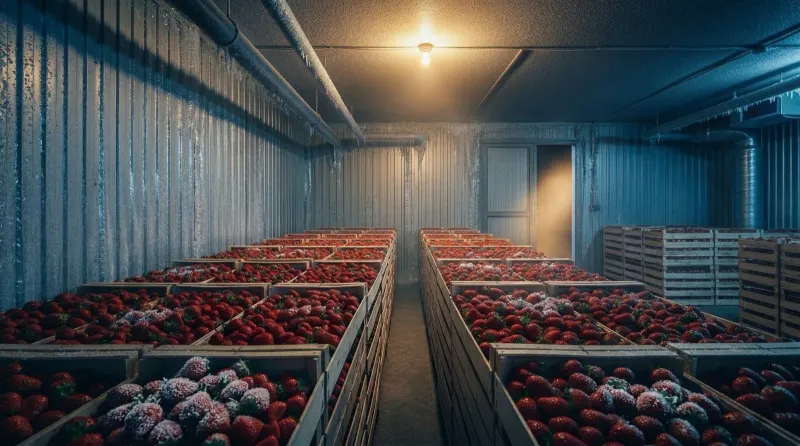
A walk-in cooler that stops cooling does not just put your inventory at risk. It sets off a chain of costs that most operators do not fully account for until they are in the middle of one. The spoiled product is the obvious loss. The emergency repair call, the downtime, the insurance claim, the compliance paperwork, and the food you cannot serve or sell while the unit is down are the costs that add up quietly behind it.
This article walks through what a cooler failure actually costs, what causes most failures, and what you can do to reduce your risk significantly. It connects closely to after-hours compressor monitoring, temperature alert thresholds for cold rooms, and cold chain integrity for Canadian produce.
Note: Cost figures referenced in this article are drawn from industry sources and will vary depending on the size of your operation, inventory levels, and local conditions. They are meant to illustrate the scale of the problem, not provide exact projections for your facility.
What is at stake when a cooler goes down
Commercial walk-in coolers typically hold anywhere from $5,000 to $50,000 in perishable inventory at any given time, depending on the size and type of operation. A mid-sized cold storage facility, the kind that many Canadian farms and food businesses rely on for post-harvest produce or processed goods, will often sit at the higher end of that range.
Canadian food safety guidelines require that perishable foods held in the danger zone (above 4°C) for more than two hours be discarded. That is an extremely narrow window. If a compressor fails overnight or over a weekend when nobody is on site, two hours can pass before anyone knows there is a problem. By the time someone opens the door on Monday morning, the inventory may already be unsalvageable.
The scale of losses adds up quickly. The FAO estimates that post-harvest losses of 20–50% are common for perishable crops between harvest and retail, with inadequate cold storage a leading cause. In Canada, avoidable food waste costs an estimated $58 billion per year across the supply chain. At the individual operation level, a single cold storage failure at a food processing facility can exceed $100,000 in direct product loss. For a farm or packing operation holding a season's harvest, even a partial loss can wipe out months of work.
The costs beyond spoiled product
Inventory loss is the largest and most visible cost, but it is rarely the only one. A cooler failure typically creates several additional expenses that compound quickly.
Emergency repair. An after-hours or weekend service call for commercial refrigeration typically costs significantly more than a scheduled visit. Parts availability can add further delays if the technician needs to order a compressor or other major component.
Rental equipment. If the repair takes more than a few hours, many operations need to rent a temporary refrigeration unit to protect remaining inventory or keep operating. Trailer-mounted cooler rentals are not cheap, and availability in rural areas can be limited.
Lost revenue. For operations that sell directly, whether a farm market, a packing operation filling orders, or a processor shipping to retailers, a cooler failure can mean cancelled orders, missed delivery windows, and customers who go elsewhere.
Labour. Staff time is consumed by the crisis: assessing the damage, coordinating with the repair company, disposing of spoiled product, cleaning the unit, and restocking. None of this is time spent on productive work.
Compliance and documentation. If your operation is subject to the Safe Food for Canadians Regulations (SFCR) or provincial health requirements, a temperature excursion needs to be documented. Depending on the severity, it could trigger a corrective action in your Preventive Control Plan and may need to be disclosed during an inspection. Operations without adequate monitoring records face additional scrutiny, because they cannot demonstrate how long the excursion lasted or when it began.
Insurance. Spoilage insurance exists and can help cover the cost of lost inventory. But many policies require documented evidence of maintenance and monitoring as a condition of the claim. If you cannot show that your equipment was maintained and that you had a reasonable system for detecting failures, the claim may be reduced or denied.
When you add these up, the total cost of a single cooler failure can easily reach two to three times the value of the lost product alone.
What causes most walk-in cooler failures
Walk-in coolers are generally reliable equipment, but they run continuously and they do fail. Understanding the most common failure points helps explain why prevention is so effective.
Dirty condenser coils. This is one of the most frequent causes of cooling problems. When condenser coils are clogged with dust, grease, or debris, the system cannot reject heat efficiently. The compressor works harder, runs hotter, and eventually fails or triggers a safety shutdown. Regular coil cleaning, quarterly at minimum, is one of the simplest and most effective maintenance tasks available.
Thermostat and sensor malfunctions. A faulty thermostat can cause the system to cycle improperly, either running too long and icing up or shutting off when the cooler still needs cooling. Sensor drift, where a temperature sensor gradually reads less accurately over time, can mask a developing problem until it becomes a failure.
Refrigerant leaks. A slow refrigerant leak reduces the system's cooling capacity over time. The compressor compensates by running longer and harder, which shortens its lifespan. By the time the cooler can no longer maintain temperature, the underlying problem may have been developing for weeks or months.
Compressor failure. The compressor is the most expensive single component in a refrigeration system, and replacing one can cost thousands of dollars plus labour. Commercial compressors typically last 8 to 10 years with proper maintenance. However, most compressor failures are not caused by age alone. They are the end result of other issues, such as dirty coils, refrigerant problems, or electrical faults, that were not caught in time.
Door seal degradation. Worn or damaged door gaskets allow warm air to infiltrate the cooler continuously. This forces the refrigeration system to work harder, increases energy consumption, and can cause ice buildup on the evaporator coils. A door seal is inexpensive to replace but easy to overlook.
Power issues. Voltage spikes, brownouts, and unstable power supply can damage compressor motors and control boards. Operations in rural areas, where power quality can be inconsistent, are particularly exposed to this risk. Surge protection is a low-cost safeguard that is often missing.
The common thread across nearly all of these failure modes is that they develop gradually. A cooler rarely goes from working perfectly to completely dead without warning signs along the way. The problem is that those warning signs, a compressor running longer than usual, a temperature creeping up by a degree or two, an energy bill ticking upward, are easy to miss without continuous monitoring.
The role of maintenance
Routine maintenance is the single most effective way to prevent cooler failures. Industry guidance generally recommends quarterly professional service at minimum, with more frequent attention for high-volume operations or older equipment.
A basic quarterly maintenance visit should include condenser coil cleaning, refrigerant level checks, electrical connection inspection, thermostat calibration verification, door gasket inspection, and drain line clearing. This kind of preventive service is not expensive relative to the cost of an emergency failure. Most commercial refrigeration service contracts run a few hundred dollars per visit.
The challenge, particularly for agricultural operations where the cold storage facility may be at a remote site, is consistency. Maintenance that happens on schedule in theory but gets pushed back in practice does not protect the equipment. And even with diligent maintenance, unexpected failures still happen. Seals fail, power surges hit, and compressors that have been running for a decade eventually wear out.
That is where monitoring comes in.
How continuous monitoring changes the math
The core problem with walk-in cooler failures is not that they are impossible to prevent. It is that they happen when nobody is watching. The compressor quits at 2 AM on a Saturday. The thermostat drifts over a long weekend. The refrigerant leak that has been slowly getting worse finally drops the system below its cooling capacity during the hottest week of the year.
A continuous monitoring system uses temperature sensors inside the cooler that take readings every few minutes and transmit them to a central dashboard. If the temperature rises above a threshold you set, you get an alert by text message or email, immediately, regardless of when it happens.
This changes the economics of cooler failure in a few important ways.
First, it dramatically reduces response time. Instead of discovering a failure hours or days after it happens, you find out within minutes. A two-hour spoilage window becomes a problem you can act on while the food is still safe.
Second, it creates a continuous record that supports both compliance and insurance. If your monitoring system shows that your cooler maintained temperature within range for the last six months and that you responded to a deviation within 30 minutes, you are in a much stronger position during an inspection or a claim.
Third, trend data can reveal developing problems before they cause a failure. A compressor that is running 20% longer than it did last month, or a cooler that is consistently sitting a degree warmer than its setpoint, are early indicators that something needs attention. Acting on these signals turns a potential emergency into a scheduled service call.
Putting it in perspective
For a typical agricultural cold storage operation, the math looks roughly like this:
A monitoring system, depending on the number of sensors and the size of the facility, generally costs somewhere in the range of a few hundred dollars per month. A single prevented spoilage event avoids thousands to tens of thousands of dollars or more in direct product loss, plus the indirect costs of emergency repair, downtime, and compliance complications.
That is not a complex return-on-investment calculation. Preventing one failure in a year more than covers the annual cost of monitoring, in most cases several times over.
The more difficult cost to quantify is the one you avoid entirely: the harvest that did not spoil, the order that shipped on time, the inspection that went smoothly because your records were complete. Prevention does not produce dramatic stories. That is the point.
Steps you can take now
If you operate a walk-in cooler and want to reduce your exposure to a costly failure, these are practical starting points.
Get on a maintenance schedule. If you do not already have a quarterly service contract with a commercial refrigeration technician, set one up. Prioritize condenser coil cleaning and refrigerant checks.
Inspect your door seals. Run your hand around the door gasket while the door is closed. If you feel cold air escaping, the seal needs to be replaced. This is a low-cost fix with an outsized impact on system longevity.
Install surge protection. If your facility is in a rural area or anywhere with inconsistent power, a surge protector on the cooler's electrical supply is cheap insurance against compressor damage.
Know your insurance coverage. Review your policy to understand whether spoilage is covered, what documentation is required to file a claim, and whether continuous monitoring records would strengthen your position.
Consider continuous monitoring. If your cooler holds more than a few thousand dollars in inventory, or if your facility is unattended overnight or on weekends, the cost of monitoring is almost certainly less than the cost of finding out about a failure too late.
A walk-in cooler failure is not a matter of if, but when. Compressors wear out. Components degrade. Power interruptions happen. The difference between a manageable repair and a devastating loss usually comes down to how quickly you find out, and whether you saw it coming.
References
-
Health Canada. "Food Safety and You." canada.ca
-
Canadian Food Inspection Agency. "Guide for Preparing a Preventive Control Plan." inspection.canada.ca
-
Canadian Food Inspection Agency. "Preventive Control Plans: Record Keeping." inspection.canada.ca
-
Second Harvest & Value Chain Management International. "The Avoidable Crisis of Food Waste." secondharvest.ca
-
FAO. "Prevention of Post-Harvest Food Losses." fao.org
-
Envigilance. "Food Processing Refrigeration Monitoring." envigilance.com
-
Contracting Business. "Don't Be a Compressor Serial Killer: Know Causes to Prevent Repeat Failures." contractingbusiness.com
-
Howard Services. "Commercial Refrigeration Compressors: How Long Do They Last?" howardserviceshvac.com
-
Insureon. "Food Spoilage Insurance Coverage." insureon.com
-
Buffo's Refrigeration. "How Walk-In Cooler Maintenance Helps Prevent Food Loss." buffos-refrigeration.com